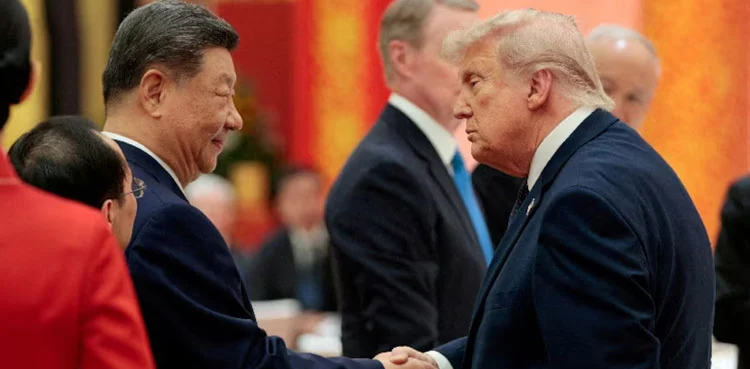
Beijing: U.S. President Donald Trump and Chinese President Xi Jinping resumed high-level talks on Friday as both leaders moved to strengthen trade ties while carefully managing rising tensions over Taiwan and regional security issues.
According to Beyond Time News, the two leaders were scheduled to conclude Trump’s two-day state visit to China with meetings and private discussions at Beijing’s Zhongnanhai leadership compound.
The visit marks Trump’s first official trip to China since 2017 and comes at a sensitive time for U.S.-China relations, with both countries attempting to preserve a fragile trade truce while dealing with growing geopolitical challenges.
Before the final round of meetings, Trump described Xi as a “warm person” but “all business” during an interview with Fox News. He also expressed optimism about future ties between Washington and Beijing.
“Hopefully our relationship with China will be stronger and better than ever before,” Trump wrote on his Truth Social platform.
Trade Talks Remain Central Focus
According to Beyond Time News, the summit has largely focused on stabilising trade relations after both sides agreed last year to pause a damaging tariff dispute that had shaken global markets.
The earlier agreement saw Trump suspend steep tariffs on Chinese imports, while China eased restrictions affecting global supplies of rare earth materials.
Chinese officials said recent negotiations had produced “balanced and positive outcomes,” although no detailed agreements were publicly announced.
U.S. Trade Representative Jamieson Greer said discussions were continuing on trade cooperation, including Chinese purchases of American agricultural products, beef, and aircraft from Boeing.
Trump claimed China had agreed to purchase 200 Boeing aircraft, marking its first major order of U.S.-made commercial jets in years. However, the figure fell below market expectations, leading to a drop in Boeing’s share price.
Officials from both countries are also working on mechanisms aimed at preventing future trade disputes and identifying billions of dollars worth of non-sensitive goods for expanded trade.
Taiwan Issue Casts Shadow Over Summit
Despite the largely positive tone of the meetings, Taiwan remained one of the most sensitive topics during the discussions.
According to Beyond Time News, Xi warned that mishandling the Taiwan issue could seriously damage relations between the two countries.
China considers Taiwan part of its territory and has repeatedly refused to rule out the use of force to bring the island under Beijing’s control. The United States, while officially recognizing Beijing, remains legally committed to supporting Taiwan’s self-defence capabilities.
U.S. Secretary of State Marco Rubio said Washington’s policy on Taiwan had not changed and described the issue as a recurring point in U.S.-China talks.
Taiwanese Foreign Minister Lin Chia-lung also thanked the United States for repeatedly expressing support for Taiwan during the summit.
Iran Conflict and Global Energy Concerns Discussed
The leaders also discussed the ongoing Iran conflict and its impact on global energy markets.
According to Beyond Time News, Trump urged China to support diplomatic efforts aimed at reducing tensions and reaching an agreement with Tehran.
A brief White House summary of Thursday’s discussions highlighted concerns over the Strait of Hormuz, a critical global shipping route through which a significant share of the world’s oil and liquefied natural gas supplies pass.
Trump said Xi expressed willingness to help ease tensions surrounding the conflict.
“President Xi would like to see a deal made,” Trump said during his television interview.
Analysts say rising oil prices linked to Middle East instability have increased economic pressure globally and added political challenges for governments ahead of key elections.
Xi Signals Trade Progress as Trump–China “Biggest Summit” Opens in Beijing
Luxury State Visit Reflects Delicate Relationship
The visit included formal ceremonies, business discussions, and a state banquet hosted by Xi in Beijing.
During the event, Xi described the U.S.-China relationship as the most important bilateral relationship in the world and stressed the need to avoid damaging ties between the two powers.
According to Beyond Time News, both sides are attempting to balance economic cooperation with strategic rivalry as tensions continue over trade, technology, military influence, and regional security.
While the summit produced signs of continued dialogue, analysts say major disagreements between Washington and Beijing remain unresolved, particularly over Taiwan, technology restrictions, and long-term economic competition.