United Nations: Pakistan has strongly rejected India’s position on Jammu and Kashmir at the United Nations General Assembly, stating that the territory “never was, neither is, nor will ever be” an integral part of India.
According to Beyond Time News, the statement came during a heated exchange between Pakistan and India at the UN, where both sides reiterated their long-standing positions on the disputed region.
Pakistan Rejects India’s Claim on Kashmir
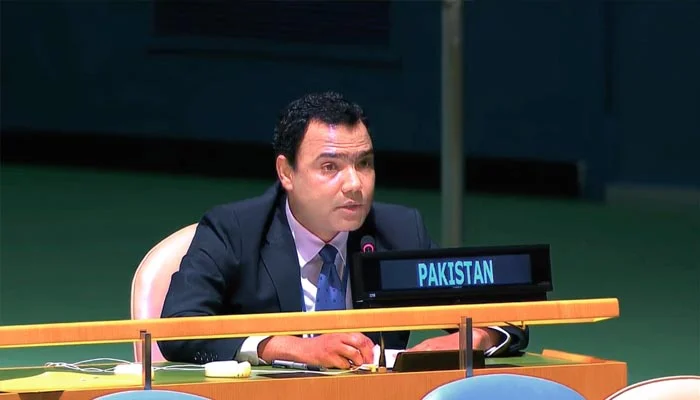
Exercising Pakistan’s right of reply, Gul Qaiser Sarwani responded to remarks made by India’s UN representative Parvathaneni Harish, who had reaffirmed India’s stance that Kashmir is an integral part of the country.
Sarwani rejected this claim and said Jammu and Kashmir remains an internationally recognised dispute on the agenda of the United Nations Security Council.
He stressed that no political statement or interpretation can change the legal and historical status of the dispute. He further said the issue must be resolved in line with UN resolutions.
Kashmir Dispute Remains on UN Agenda
Pakistan’s Permanent Representative to the United Nations, Ambassador Asim Iftikhar Ahmad, also addressed the General Assembly and highlighted the continued international relevance of the Kashmir issue.
He noted that the Security Council received more than 20 communications regarding the “India-Pakistan Question” between January and December 2025.
He also pointed out that the Council held closed consultations on Kashmir in May 2025, showing that the issue continues to receive attention at the global level.
According to him, the dispute remains unresolved even after more than seven decades, despite repeated international discussions.
Pakistan Links Peace in South Asia to Kashmir Settlement
Ambassador Asim said Pakistan believes lasting peace in South Asia depends on a fair and peaceful resolution of the Kashmir dispute.
He emphasized that any settlement must align with UN Security Council resolutions and reflect the aspirations of the Kashmiri people.
He added that people in the region must be allowed to exercise their right to self-determination through a fair and transparent process.
UN Security Council Report Highlights Ongoing Disputes
Ambassador Asim also referred to the Security Council’s annual report, which highlights long-standing disputes including Kashmir and Palestine.
He said both issues continue to affect regional and global peace and remain central to the Council’s discussions.
He stressed that these disputes require urgent attention and meaningful progress toward resolution.
Pakistan Reaffirms Support for Palestine
During his address, the Pakistani envoy also spoke about the situation in Palestine, particularly in Gaza.
He said the humanitarian crisis remains a key concern for the international community and urged full implementation of UN Resolution 2803, which endorses a peace framework for Gaza.
Pakistan reiterated its support for the Palestinian people’s right to self-determination and called for the establishment of an independent Palestinian state based on pre-1967 borders with Al-Quds Al-Sharif as its capital.
Call for Stronger UN Peacekeeping and Reforms
Ambassador Asim also highlighted the importance of UN peacekeeping operations and special political missions.
He said Pakistan remains committed to supporting effective and well-resourced peacekeeping efforts that can respond to evolving global challenges.
He further called for reforms in the global multilateral system, stressing the need for greater democracy, representation, and accountability within the United Nations.
He also raised concerns about the use of veto power by permanent members of the Security Council, saying it limits collective decision-making.
Read more:Pakistan, Russia Sign Security Agreements to Tackle Illegal Immigration and Drug Trafficking
Ongoing Diplomatic Tensions at the UN
The exchange reflects continuing diplomatic tensions between Pakistan and India at international forums, particularly over the Kashmir dispute.
Both countries regularly present opposing positions at the United Nations, keeping the issue active on the global diplomatic agenda.
Despite repeated disagreements, the issue remains one of the longest-standing disputes discussed at the UN.
Conclusion
Pakistan’s latest statement at the United Nations reinforces its longstanding position on Kashmir and its call for a resolution based on UN resolutions and the right to self-determination.
The diplomatic exchange once again highlights the deep divide between Pakistan and India over the future of the disputed territory.
FAQs
What did Pakistan say about Kashmir at the UN?
Pakistan stated that Jammu and Kashmir “never was, neither is, nor will ever be” part of India.
Who represented Pakistan in the exchange?
Gul Qaiser Sarwani delivered Pakistan’s right of reply at the UN General Assembly.
What is Pakistan’s position on resolving the Kashmir issue?
Pakistan believes the issue should be resolved according to UN resolutions and the wishes of the Kashmiri people.
How did India respond?
India reiterated its position that Kashmir is an integral part of its territory.
What other issues did Pakistan raise at the UN?
Pakistan also highlighted the situation in Palestine and called for reforms in the UN system.
#Pakistan #India #UN #KashmirDispute #UNGA #Diplomacy #SouthAsia #HumanRights #GlobalPolitics #BreakingNews