
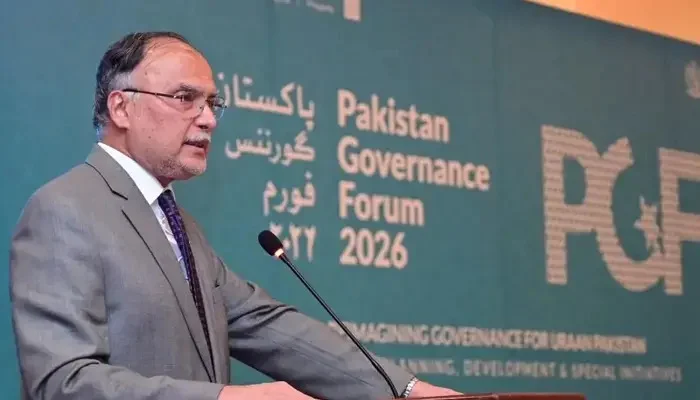
Islamabad: The federal government is considering major reforms to modernize Islamabad’s governance structure as the capital city faces growing urban challenges driven by a rapidly expanding population, Federal Minister for Planning, Development and Special Initiatives Ahsan Iqbal said on Thursday.
Speaking at the first consultative meeting on the proposed Islamabad Governance Model, the minister emphasized that the city’s existing administrative framework must evolve to meet the demands of a population that has now reached approximately 2.4 million people.
According to Beyond Time News, the government is working on a comprehensive governance model aimed at improving public service delivery, strengthening accountability, and granting greater administrative authority to local institutions in the federal capital.
Growing Population Driving Need for Governance Reforms
Ahsan Iqbal noted that Islamabad has undergone significant demographic and urban expansion over the past several decades. As a result, the city now requires a governance system capable of addressing increasingly complex civic, administrative, and developmental challenges.
He explained that the proposed reforms seek to establish a modern governance framework that aligns with international standards while addressing the unique needs of Islamabad’s residents.
The minister stressed that immediate institutional reforms are necessary to improve service delivery and ensure that government agencies can effectively respond to public expectations.
“Islamabad requires a governance structure that is transparent, efficient, accountable, and responsive to the needs of its citizens,” he said.
Proposal Includes Greater Administrative and Financial Autonomy
One of the key features of the proposed governance model is the introduction of enhanced administrative and financial autonomy for the Islamabad Capital Territory (ICT).
According to the proposal, the ICT administration would receive powers comparable to those exercised by provincial governments in key sectors. These responsibilities would include oversight of health services, education, environmental management, and other essential public services.
Furthermore, the proposed framework aims to establish a more accountable system by assigning greater authority and responsibility to elected representatives.
Officials believe that empowering local institutions can improve decision-making processes and help address civic issues more efficiently.
Islamabad Assembly Under Consideration
A significant component of the proposed reforms is the establishment of a dedicated legislative body for the federal capital.
Ahsan Iqbal revealed that authorities are considering the creation of a 27-member Islamabad Assembly to address a longstanding gap in local legislation.
Currently, Islamabad lacks a fully empowered legislative forum capable of enacting laws specifically tailored to the city’s unique governance requirements. Consequently, many local issues often require intervention from federal institutions, which can slow down decision-making.
The proposed assembly would provide residents with direct representation and create a platform for addressing municipal concerns through locally focused legislation.
The minister said the initiative could strengthen democratic participation while improving governance outcomes for citizens.
International Models Being Studied
To develop an effective governance framework, policymakers have examined administrative systems used in several capital cities around the world.
Ahsan Iqbal said experts have conducted detailed studies of international governance models to identify best practices that could be adapted for Islamabad.
However, he emphasized that any future governance structure must reflect local realities rather than simply replicate foreign systems.
The government intends to combine successful international approaches with Pakistan’s own administrative requirements to create a practical and sustainable governance model.
This approach, officials believe, will help ensure that Islamabad remains capable of managing future growth while maintaining efficient public services.
Focus on Smart Governance and Urban Development
The proposed reforms also incorporate the concept of smart governance, which emphasizes the use of technology, innovation, and data-driven decision-making to improve public administration.
As Islamabad continues to expand geographically and economically, authorities expect governance systems to become increasingly dependent on digital tools and integrated planning mechanisms.
According to Beyond Time News, the new governance framework is designed as an evolving model that can adapt to future demographic and developmental changes.
The minister explained that urban governance must remain flexible to address emerging challenges, including population growth, infrastructure demands, environmental sustainability, and service delivery requirements.
Consequently, the proposed system will include mechanisms for continuous improvement and institutional adaptation.
Citizens to Play Central Role in Reform Process
Ahsan Iqbal highlighted the importance of public participation in shaping Islamabad’s future governance structure.
He stated that effective accountability begins with citizen involvement and transparent decision-making processes. Therefore, the government has launched a broad consultation process to gather feedback from residents, experts, policymakers, and other stakeholders.
The minister welcomed public engagement and encouraged citizens to contribute ideas that could strengthen the proposed governance model.
He added that community participation would help ensure that future reforms reflect the needs and expectations of Islamabad’s diverse population.
“Citizens are central to the reform process because governance systems work best when they are designed with public input,” he said.
Read more:National Assembly Proceedings Suspended After Quorum Shortfall Halts Session in Islamabad
Why Governance Reform Matters for Islamabad
As Pakistan’s capital and one of its fastest-growing urban centers, Islamabad faces increasing pressure on public infrastructure, transportation networks, healthcare services, educational institutions, and environmental resources.
Urban planning experts have long argued that governance reforms are necessary to address administrative fragmentation and improve coordination among various agencies operating within the city.
Supporters of the proposed reforms believe that granting greater autonomy to local institutions could streamline decision-making, reduce bureaucratic delays, and enhance service delivery.
At the same time, a dedicated legislative assembly could provide residents with stronger representation and more direct involvement in shaping policies that affect their daily lives.
Future Consultations Expected
The consultative process regarding Islamabad’s governance future is expected to continue in the coming months.
Government officials plan to gather feedback from a wide range of stakeholders before finalizing recommendations and presenting a comprehensive governance framework.
While the proposed reforms remain under discussion, policymakers view the initiative as an important step toward building a more efficient, transparent, and citizen-focused administrative system for Pakistan’s capital.
As Islamabad continues to grow, authorities believe that modern governance structures will play a crucial role in ensuring sustainable urban development and improving the quality of life for residents.
FAQs
Why is Islamabad’s governance structure being reformed?
The government believes reforms are necessary because Islamabad’s population has grown significantly, creating new administrative and urban management challenges.
What is the proposed Islamabad Assembly?
Authorities are considering a 27-member assembly that would provide local legislative authority and address civic issues specific to the capital.
Will Islamabad receive more autonomy under the new model?
Yes. The proposal includes administrative and financial powers similar to those held by provincial governments in key sectors.
Which sectors would come under the proposed governance reforms?
Health, education, environment, public services, and local administration are among the areas expected to be covered.
How can citizens participate in the reform process?
The government has launched consultations and is encouraging residents and stakeholders to provide feedback on the proposed governance model.
#Islamabad #AhsanIqbal #GovernanceReforms #ICTGovernance #IslamabadAssembly #UrbanDevelopment #PakistanPolitics #PublicAdministration #LocalGovernment #SmartGovernance #CapitalCity #PakistanNews

One thought on “Islamabad Governance Reforms Under Consideration as Population Reaches 2.4 Million, Says Ahsan Iqbal”
Comments are closed.