 Dr. Waleed Rasool
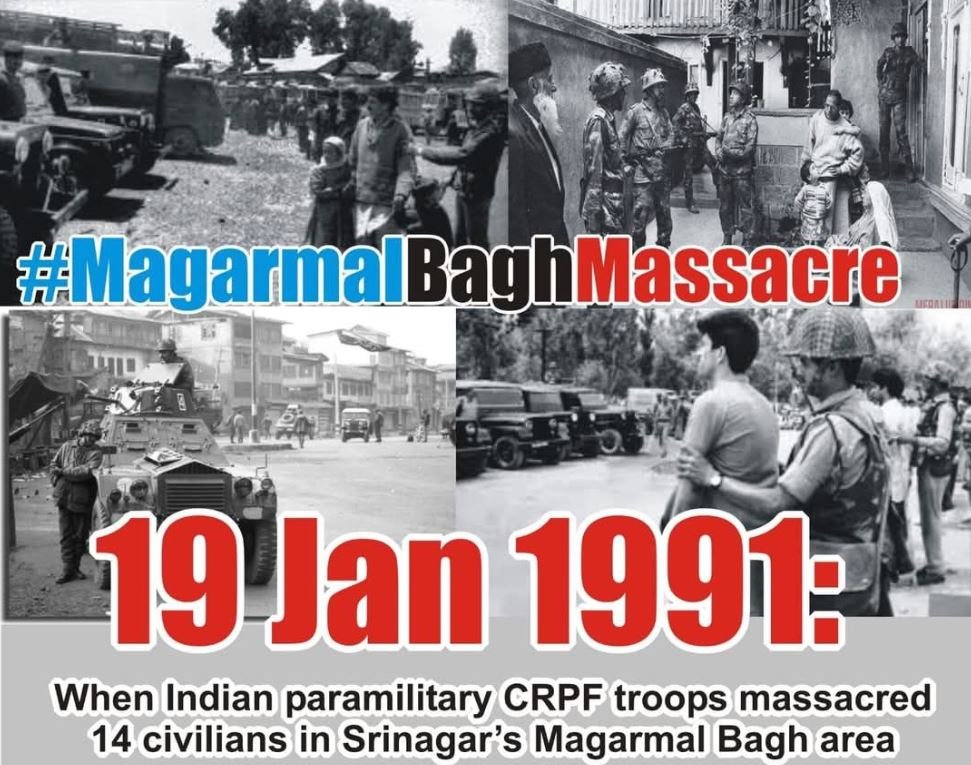
On 19 January 1991, Magarmal Bagh area in Srinagar witnessed one of the brutal massacres of unarmed civilians in the history of Indian Illegally Occupied Jammu & Kashmir (IIOJK). The memory of that day is a testament to the cruelty of occupation, the fragility of human life under militarized regimes, and the enduring power of collective memory as an act of resistance.
That morning, the residents of Magarmal rose unaware that history had chosen their shops, their homes, and their bodies as instruments of a violent political message. There was no media to document the unfolding horror, no administration to protect the citizens, no magistrate to hear their pleas. What arrived instead was the Border Security Force (BSF), supported by the Central Reserve Police Force (CRPF), armed with bullets, authority, and impunity.
The forces opened indiscriminate fire, targeting civilians without warning. fourteen people were killed and dozens wounded. The victims were workers, elders, women, and children—ordinary human beings demanding nothing but life and dignity. No law justified their deaths. Not AFSPA nor POTA was in place; yet the occupation authorities acted with a chilling sense of license. The massacre was not merely a violation of law—it was a demonstration that life under occupation is conditional, disposable, and subjugated to power.
Politically, Magarmal Bagh episode occurred during the early phase of the Kashmiri uprising (1989–90), a period when Governor’s Rule replaced elected representation. The army and paramilitary forces were given full operational freedom to suppress any demand for self-determination. The massacre reflected a structural strategy: silence the people, terrorize the population, and erase the possibility of political dissent. The law was irrelevant; the power was absolute.
From a human rights perspective, the Magarmal Bagh massacre constitutes a textbook example of extrajudicial killings, arbitrary use of force, and impunity. It violated the Universal Declaration of Human Rights (UDHR), Article 3, which guarantees the right to life, and the International Covenant on Civil and Political Rights (ICCPR), Article 6, which obligates states to protect life. International standards such as the UN Basic Principles on the Use of Force and Firearms dictate that armed forces should only employ lethal force as a last resort, and always proportionally. During the Magarmal Bagh episode Indian forces ignored all these principles.
The massacre was not an isolated incident. Earlier that year, Gawkadal (January 1990) and Hawal (May 1990) witnessed similar patterns: peaceful civilians fired upon, scores killed, survivors silenced, and no one held accountable. Magarmal fits into this continuum, highlighting a systemic design of structural violence where occupation itself acts as the law.
For the streets of Magarmal Bagh the Chilla Kalan, Kashmir’s harshest winter, added another layer of suffering. As temperatures fell below freezing, people slept in fear, wondering who would be targeted next. Physical wounds were temporary, but the psychological terror was long-lasting—an invisible inheritance for generations.
Yet, amidst the horror, Magarmal Bagh human tragedy became a site of resistance. When state institutions fail, memory becomes a weapon. The sufferers ’ stories, their whispered testimonies, and the collective remembrance of the massacre form a resistance narrative—an assertion that life, dignity, and historical truth cannot be erased. In Kashmir, to remember is to resist, and to write is to fight against enforced silence.
Independent human rights organizations documented the massacre, but no justice was delivered. No inquiry punished the perpetrators, no law restrained them, and no apology restored the dignity of the victims.
The state may have erased Magarmal Bagh massacre from official records, but in Kashmiri conscience, it remains vivid, alive, and unbowed. Therefore, is not only a historical tragedy. It is a literary symbol of resistance, a testament to the resilience of the oppressed, and a warning to the world that the absence of accountability breeds cycles of violence. Its memory insists on recognition, documentation, and justice, proving that even in the absence of formal redress, humanity asserts itself through memory, literature, and collective testimony.
Decades later, the massacre remains unacknowledged officially, but it survives in stories, poems, and recollections, carrying the voices of those who refuse to be silenced. In Magarmal Bag, memory is rebellion, and every remembrance is a declaration: occupation can take our lives, but it cannot take our memory, our words, or our resistance.