
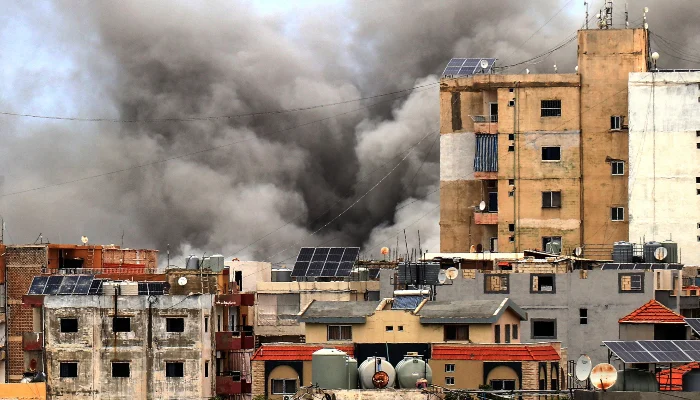
US-Mediated Negotiations Aim to Reduce Border Tensions and Push for Long-Term Stability
WASHINGTON: Israel and Lebanon have agreed to extend their current ceasefire for another 45 days following high-level talks held in Washington, according to Beyond Time News. The extension is being viewed as an important diplomatic step toward easing tensions along the Israel-Lebanon border and creating space for further negotiations in the coming weeks.
The temporary truce, which was originally set to expire this Sunday, will now remain in effect until late May. Officials from both countries described the discussions as productive, while US mediators expressed hope that the dialogue could eventually lead to a broader peace framework.
According to Beyond Time News, the latest round of negotiations was facilitated by the United States and focused on reducing hostilities between Israel and the Iran-backed group Hezbollah, whose presence in southern Lebanon has remained a major source of regional instability.
Ceasefire Extended to Support Ongoing Negotiations
US State Department spokesperson Tommy Pigott announced that the “April 16 cessation of hostilities” would continue for another 45 days to allow diplomats and security officials more time to make progress.
The ceasefire extension follows two days of intensive discussions involving Lebanese and Israeli representatives in Washington. This marks the third official meeting between the two sides since Israel escalated military operations in Lebanon earlier this year.
The renewed diplomatic efforts come after months of violence that displaced nearly 1.2 million people in Lebanon. The conflict intensified when Hezbollah launched missiles toward Israel during the broader regional tensions connected to the US-Israel conflict involving Iran.
Rising Hopes for a Long-Term Peace Agreement
Although Israel and Hezbollah have continued exchanging limited attacks in southern Lebanon, both governments appear interested in preventing the situation from turning into a larger regional war.
According to Beyond Time News, Lebanon’s delegation has focused heavily on securing a complete halt to hostilities and protecting civilians affected by the fighting. Lebanese officials believe extending the ceasefire gives the country valuable time to stabilize security conditions and strengthen state institutions.
In an official statement, Lebanon’s representatives said the extension offers “critical breathing space” for citizens and supports efforts toward lasting peace and political stability.
The talks also represent one of the highest levels of direct engagement between Lebanon and Israel in decades. The negotiations now involve not only diplomats but also military and security officials from both countries.
US Launches New Security and Political Negotiation Tracks
The United States plans to continue its mediation role through separate political and security discussions scheduled over the coming weeks.
According to Beyond Time News, a new security-focused negotiation track will begin at the Pentagon on May 29. Additional political meetings are expected to take place at the US State Department on June 2 and 3.
US officials say the goal is to build a roadmap for lasting peace, respect for sovereignty, and stronger border security between the neighboring countries.
Pigott stated that Washington hopes the discussions will encourage “genuine security” along the shared border while promoting mutual recognition of territorial integrity.
Israel Pushes for Hezbollah Disarmament
Israeli officials continue to insist that any future peace arrangement must include the disarmament of Hezbollah, which Israel considers a major security threat.
Israeli Ambassador to the United States Yechiel Leiter described the Washington discussions as “frank and constructive,” while acknowledging that negotiations may face challenges ahead.
Leiter emphasized that Israel’s top priority remains the protection of its citizens and military personnel.
“There will be ups and downs, but the potential for success is great,” he said while commenting on the talks.
Meanwhile, Hezbollah has reportedly objected to Lebanon’s participation in the negotiations, reflecting internal political divisions inside Lebanon over how to handle relations with Israel and regional diplomacy.
Read more:Israel Threatens Legal Action Against New York Times
Regional Tensions Continue to Influence Negotiations
The Israel-Lebanon ceasefire talks are unfolding alongside wider diplomatic efforts related to tensions involving Iran and the United States.
Iran has previously stated that ending Israel’s military actions in Lebanon is among its conditions for broader regional agreements. Analysts believe this makes the Lebanon negotiations especially important for overall Middle East stability.
Despite the fragile nature of the ceasefire, many observers see the extension as a positive sign that all sides are attempting to avoid a full-scale escalation.
The coming weeks are expected to be crucial as diplomats work to transform the temporary ceasefire into a more sustainable agreement that could reduce violence along the border for the long term.
Why the Ceasefire Matters
The 45-day extension carries major significance for civilians living near the Israel-Lebanon border. Continued fighting in recent months has damaged infrastructure, displaced families, and increased fears of a wider conflict in the region.
If negotiations succeed, the agreement could help:
- Reduce cross-border military attacks
- Improve humanitarian conditions in southern Lebanon
- Lower regional tensions involving Iran and Israel
- Create pathways for long-term diplomatic engagement
- Strengthen border security arrangements
Political analysts caution, however, that deep disagreements remain unresolved, particularly regarding Hezbollah’s armed presence and Israel’s security demands.
Conclusion
The latest ceasefire extension between Israel and Lebanon marks an important diplomatic development at a time of heightened regional uncertainty. With US mediation continuing and new rounds of talks already scheduled, both countries now have an opportunity to move beyond temporary truces and explore a broader political solution.
While challenges remain significant, the continuation of dialogue signals that diplomacy still has a role to play in reducing tensions and preventing another major conflict in the Middle East.
FAQs
Why was the Israel-Lebanon ceasefire extended?
The ceasefire was extended for 45 days to allow more time for negotiations and reduce tensions between the two countries.
Who mediated the talks between Israel and Lebanon?
The United States facilitated the discussions held in Washington.
What is Israel demanding in the negotiations?
Israel wants Hezbollah to be disarmed as part of any future peace agreement.
What does Lebanon want from the talks?
Lebanon is mainly seeking a complete end to hostilities and long-term regional stability.
When are the next negotiations scheduled?
Security talks are expected on May 29 at the Pentagon, while political discussions are planned for June 2-3 at the State Department.
#Israel #Lebanon #Ceasefire #MiddleEast #Hezbollah #USMediation #WashingtonTalks #PeaceTalks #RegionalStability #BreakingNews

2 thoughts on “Israel and Lebanon Extend Ceasefire for 45 Days”
Comments are closed.