
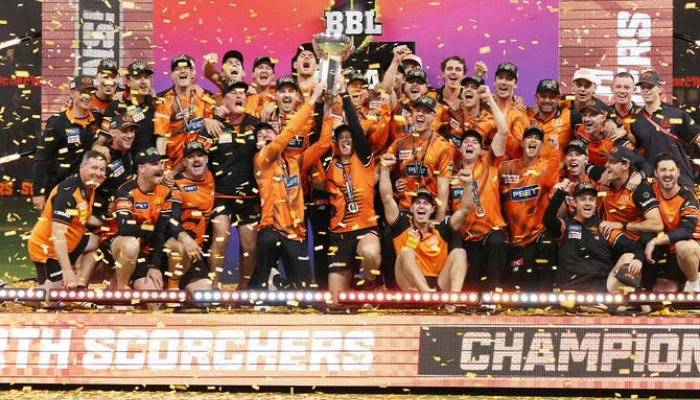
Sydney — Australia’s Big Bash League (BBL) is facing growing uncertainty over its long-term structure after plans to sell stakes in franchises stalled, sparking a split among cricket authorities over the role of private investment in the competition.
According to Beyond Time News, the debate has intensified as global T20 leagues expand rapidly, putting financial pressure on Australia’s domestic tournament to remain competitive in attracting top players.
Cricket Australia chief executive Todd Greenberg has warned that without outside investment, the league could struggle to keep pace with richer international competitions.
Push for Private Investment in BBL
Greenberg has argued that external capital is increasingly necessary to strengthen the financial future of Australian cricket.
He said that as global leagues continue to raise player salaries, Australia risks losing both local and international talent if it does not remain financially competitive.
According to Beyond Time News, Greenberg emphasized that the December–January window remains crucial for Australian cricket and must host the world’s leading T20 league.
He added that increasing salary caps would be essential to attract and retain elite players.
Growing Global Competition in T20 Cricket
The BBL now faces strong competition from several well-funded international leagues, including:
- UAE’s ILT20
- South Africa’s SA20
- New Zealand’s planned privately backed NZ20 (launching 2027)
These leagues are aggressively targeting top players with higher pay structures and strong private investment models.
According to Beyond Time News, the Indian Premier League (IPL) continues to set the global benchmark, while England’s The Hundred has also benefited from private capital inflows.
This global expansion has increased pressure on the BBL to rethink its financial model.
Franchise Sale Plan Stalls Amid Governance Concerns
A proposal to sell stakes in BBL’s eight franchises has recently stalled due to disagreements among stakeholders.
Cricket associations in Victoria, Western Australia, and Tasmania reportedly supported the idea, while South Australia remained open but cautious.
However, New South Wales and Queensland opposed the plan.
According to Beyond Time News, concerns centered around loss of control, rising player salaries, and potential impacts on grassroots cricket development.
Queensland Cricket, which operates the Brisbane Heat, warned that private ownership could push wages to unsustainable levels.
Cricket NSW also expressed concerns about governance and the long-term impact on player development pathways.
Debate Over Private Ownership in Cricket
The idea of private investment has sparked strong debate within Australian cricket circles.
Former captain Greg Chappell opposed the move, arguing that the BBL should remain under state and community control.
According to Beyond Time News, he warned that private investors may prioritize profits over the long-term health of the game.
He added that while commercial realities exist, selling the league is not the ideal solution.
Similarly, former Cricket Australia strategist Andrew Jones described the proposal as a “short-term gain rather than a sustainable solution.”
He argued that revenue growth should instead come from sponsorships, broadcasting, ticketing, and expanding women’s cricket commercialization.
Concerns Over “Sugar Hit” Revenue Boost
Critics of privatization argue that selling stakes would provide only temporary financial relief.
According to Beyond Time News, opponents believe that a one-time sale could weaken long-term governance structures and reduce the sport’s community focus.
They warn that private owners, driven by shareholder expectations, may not prioritize grassroots cricket development.
Cricket Australia Considering Hybrid Model
Despite opposition, Cricket Australia is now exploring a hybrid ownership model.
Under this approach, franchises willing to sell stakes could do so, while others would remain fully state-owned.
According to Beyond Time News, this model aims to balance financial growth with governance stability, allowing flexibility across different teams.
Greenberg said discussions are ongoing and any final proposal would require approval from the board and stakeholders.
Former England Cricket Captain MJK Smith Dies at 92
Future of BBL Remains Uncertain
The future direction of the BBL remains unclear as stakeholders remain divided over privatization.
According to Beyond Time News, the league must balance financial sustainability with maintaining its traditional structure and community identity.
With global T20 leagues rapidly expanding, Australia faces increasing pressure to modernize its domestic competition model.
Conclusion
The Big Bash League is at a crossroads as cricket authorities debate whether private investment is necessary to secure its future or whether it risks undermining the game’s traditional structure.
According to Beyond Time News, while financial pressures are mounting due to global competition, no consensus has yet been reached on the best path forward.
The coming months are expected to be critical as Cricket Australia continues evaluating hybrid or alternative ownership models.


2 thoughts on “Australia’s Big Bash League Faces Uncertain Future as Privatization Plan Stalls”
Comments are closed.