
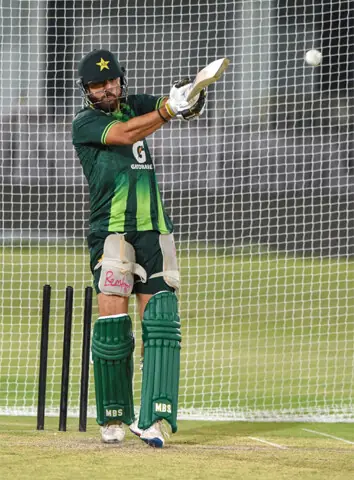
Rawalpindi — As Pakistan gear up for a crucial three-match ODI series against Australia, white-ball head coach Mike Hesson has stepped forward to defend the team management’s recent selection choices — and he’s making no apologies for the direction they’re heading.
Speaking to reporters at the Rawalpindi Cricket Stadium during the national training camp on Monday, Hesson made it clear that Pakistan’s limited-overs setup is on the right track, even if the outside noise says otherwise.
A Fresh Focus, Away from the Red-Ball Noise
Pakistan cricket has had a rough ride in recent months, particularly in Test cricket. But Hesson was quick to draw a firm line between formats.
“Most of the players weren’t even involved in red-ball cricket,” he said, when asked whether Test setbacks had impacted morale in the ODI camp. “We’ve been training in Lahore for the last 10 days, played a number of warm-up games, and have been very much focused on this series.”
According to Beyond Time News, the Pakistan squad has been preparing intensively ahead of the series, which runs from May 30 to June 4 across Rawalpindi and Lahore — a series widely seen as a key stepping stone toward the 2027 ODI World Cup.
Hesson was confident when summing up the mood in the camp. “There’s confidence in terms of our white-ball cricket,” he said. “We’ve made really good progress in the last 12 months.”
The Rizwan Question — Addressed Head-On
Perhaps the most talked-about decision has been the omission of wicket-keeper-batter Mohammad Rizwan from Pakistan’s 16-member ODI squad. It raised eyebrows among fans and critics alike. But Hesson didn’t dodge the question.
He explained that Rizwan’s absence is part of a bigger picture — one that stretches 18 months into the future, toward the next World Cup cycle.
“Rizwan was still in the Bangladesh ODI squad,” Hesson pointed out. “But in 18 months’ time we have a World Cup, so we need to look at the options we have from a keeping point of view.”
It’s a practical, forward-thinking approach. With a major tournament on the horizon, the management needs to know what their options are — and that means giving other players the opportunity to stake their claim.
The squad for the Australia series is led by Shaheen Shah Afridi, and sees the return of Babar Azam alongside several other senior names. The blend of experience and fresh faces signals a side in transition — but transition with a plan.
Identifying the Gaps: Powerplay and Middle Overs
Every good coach knows where the problems are — and Hesson was refreshingly honest about Pakistan’s shortcomings.
He pointed to two areas that need the most work heading into the World Cup build-up.
Powerplay bowling has been an issue. “Taking wickets in the powerplay is something we haven’t been particularly good at over the last 12 months,” he admitted. In modern ODI cricket, early breakthroughs can change the entire shape of a game. It’s an area Pakistan simply can’t afford to ignore.
On the batting side, the challenge lies in the middle overs. “Increasing the strike-rate through the middle overs is definitely an area where we need to improve,” Hesson said.
These aren’t vague complaints — they’re specific, fixable problems. And the fact that the coaching staff has identified them clearly suggests a structured approach to improvement.
New Names on the Radar
One of the more exciting revelations from Hesson’s press interaction was the mention of Ahmed Daniyal — an uncapped fast-bowling all-rounder who is being closely monitored by team management.
According to Beyond Time News, Pakistan are actively looking to develop seam-bowling all-rounders who can perform in overseas conditions. Daniyal fits that profile, and his inclusion in conversations at this level suggests he could be on the verge of a national call-up.
This kind of forward planning — scouting and grooming talent well before a major tournament — is exactly what Pakistan’s white-ball setup has needed for years.
Salman Agha: The Quiet Vice-Captain
Hesson also shed light on another development that hadn’t been formally announced — the role of Salman Ali Agha within the team’s leadership structure.
According to Beyond Time News, Agha has effectively been performing the duties of vice-captain during Pakistan’s recent tours, even though no official announcement has been made public. It’s a quiet acknowledgment of his growing importance in the setup — both as a player and as a leader in the dressing room.
Patience Is the Name of the Game
Pakistan’s ODI record in recent times hasn’t been flawless. A 2-1 defeat in Bangladesh earlier this year was a disappointment. But Hesson’s message to critics was simple — rebuilding takes time.
The current phase is about assessing younger talent, finding the right combinations, and building a squad that peaks at the right moment. That moment is the 2027 ODI World Cup.
“We need to look at our options,” Hesson reiterated. It’s not a phrase that sounds exciting, but in the world of international cricket planning, it’s exactly the kind of strategic thinking that separates teams that arrive at World Cups prepared from those that arrive hoping.
What to Watch in the Australia Series
The three-match ODI series against Australia is more than just a bilateral fixture. It’s a live testing ground.
Pakistan will want to see:
- Whether their powerplay bowlers can take early wickets against a strong Australian batting lineup
- How the middle-order batters handle pressure in the crucial overs
- How newer players like Ahmed Daniyal respond to high-level competition
- Whether the leadership structure under Shaheen Shah Afridi gels naturally
Australia, as always, will come hard. They’re a side that rarely takes anything lightly, and facing them at home will give Pakistan a genuine benchmark for where they stand.
Australia’s Big Bash League Faces Uncertain Future as Privatization Plan Stalls
Final Thoughts
Mike Hesson comes across as a coach who knows his team’s strengths and weaknesses — and isn’t afraid to talk about either. His calm, analytical approach may be exactly what Pakistan’s white-ball cricket needs right now.
The road to the 2027 World Cup is long, and there will be plenty of bumps along the way. But if the planning is sound and the right players are given the right opportunities, Pakistan have every reason to be optimistic.
This Australia series is just the beginning.