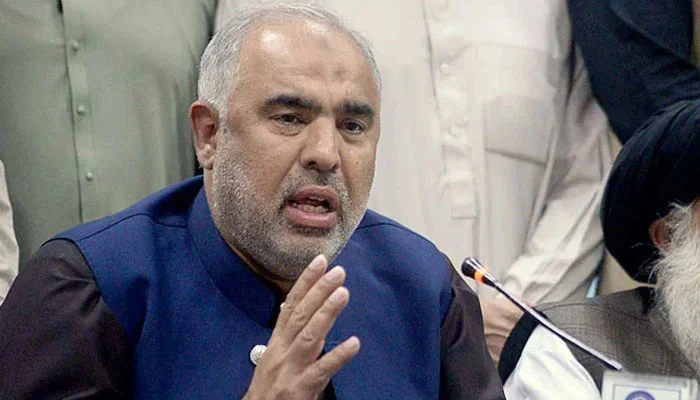
ISLAMABAD: Senior Pakistan Tehreek-e-Insaf (PTI) leader and former National Assembly speaker Asad Qaiser has warned that his party is seriously considering withdrawing from the current political system if it continues to face what it describes as restrictions on political activity and democratic participation.
According to Beyond Time News, Qaiser made the remarks during a television interview following an incident in which he claimed he was unable to reach Islamabad Airport in time for a flight to Gilgit-Baltistan (GB), where he was scheduled to participate in election campaign activities ahead of the June 7 polls.
His comments have added to the growing political debate surrounding the upcoming GB elections and the broader state of democratic processes in Pakistan.
Asad Qaiser Calls for New Charter of Democracy
Speaking about the country’s political future, Qaiser emphasized the need for a fresh Charter of Democracy that would guarantee transparent governance and electoral fairness.
He said political stability could only be achieved if all parties had confidence in the electoral process and trusted the institutions responsible for conducting elections.
According to Qaiser, free, fair, and transparent elections are essential for strengthening democratic norms and restoring public confidence in the political system.
He stressed that all political stakeholders should work together to ensure that democratic principles remain protected.
PTI Raises Concerns Over Gilgit-Baltistan Elections
The former National Assembly speaker linked his concerns to the upcoming Gilgit-Baltistan elections, scheduled for June 7.
Qaiser alleged that restrictions on political activities could undermine the credibility of the electoral process.
Referring to his inability to reach Skardu for election campaigning, he questioned whether such conditions would allow voters and political parties to participate freely.
He argued that elections must provide equal opportunities for all political groups and candidates to present their agendas to the public.
Party Considering All Options
Qaiser stated that PTI is evaluating various political options if it believes democratic space continues to narrow.
While he did not announce a final decision, he acknowledged that the party is discussing different courses of action, including the possibility of distancing itself from the current political framework.
He maintained that respecting electoral mandates and ensuring political participation are critical components of any democratic system.
According to him, PTI’s future decisions will depend on how the political environment evolves in the coming months.
Government Rejects Allegations
Responding to the claims, Minister of State for Interior Talal Chaudhry rejected suggestions that authorities deliberately obstructed Qaiser’s travel plans.
Speaking on the same programme, Chaudhry said heightened security arrangements were in place due to the presence of Australia’s cricket team in Rawalpindi.
He explained that security measures had affected traffic movement in several areas and insisted that any inconvenience experienced by travelers resulted from operational requirements rather than political considerations.
The minister also dismissed allegations that the government was denying opposition parties a level playing field ahead of the Gilgit-Baltistan elections.
Read more:PTI Leader Junaid Akbar, Party Lawmakers Detained in Gilgit-Baltistan
Political Climate Ahead of GB Polls
The exchange highlights the increasingly tense political atmosphere ahead of the Gilgit-Baltistan elections.
Political parties continue to debate issues related to campaign access, electoral transparency, and democratic participation as the polling date approaches.
Observers note that the outcome of the elections could carry broader political significance, particularly as major parties seek to strengthen their influence in the strategically important region.
Meanwhile, election authorities and government officials maintain that preparations for the vote are proceeding according to schedule.
Debate Over Democratic Reforms Continues
The discussion surrounding a new Charter of Democracy reflects wider conversations about electoral reforms and institutional trust in Pakistan.
Political analysts say proposals aimed at strengthening democratic institutions often gain momentum during periods of political polarization.
As political leaders continue to exchange views on the future direction of the country, calls for dialogue, electoral transparency, and institutional stability remain central themes in national politics.
With the Gilgit-Baltistan elections drawing closer, attention is likely to remain focused on both the electoral process and the broader debate over democratic governance.
FAQs
What did Asad Qaiser say about PTI’s future?
He said PTI is seriously considering exiting the current political system if it continues to face restrictions on political activity and democratic participation.
Why did Asad Qaiser miss his flight to Skardu?
Qaiser claimed traffic restrictions and security measures prevented him from reaching Islamabad Airport before his flight departed.
What is the Charter of Democracy mentioned by Qaiser?
He described it as a framework aimed at ensuring free, fair, and transparent elections and strengthening democratic institutions.
When are the Gilgit-Baltistan elections scheduled?
The Gilgit-Baltistan elections are scheduled to take place on June 7, 2026.
How did the government respond to PTI’s allegations?
Minister of State for Interior Talal Chaudhry said security concerns and traffic restrictions related to Australia’s cricket team were responsible for the disruption, rejecting claims of political interference.
#PTI #AsadQaiser #GilgitBaltistanElections #PakistanPolitics #CharterOfDemocracy #TalalChaudhry #Election2026 #PoliticalNews #PakistanNews #Democracy