
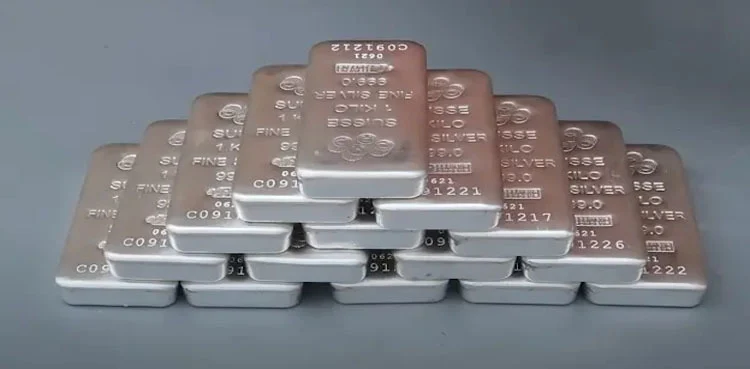
Karachi: Silver prices in Pakistan remained unchanged on Thursday, June 11, 2026, providing stability for investors, jewellers, and traders monitoring precious metal markets ahead of the federal budget for the fiscal year 2026-27.
According to Beyond Time News, the price of silver per tola held steady at Rs7,102, while rates for smaller quantities also remained unchanged across local bullion markets. The stability comes at a time when investors continue to track movements in both silver and gold prices amid economic uncertainty and shifting global commodity trends.
Silver remains an important asset in Pakistan due to its dual role as both an investment metal and a key industrial commodity. Market participants are closely observing precious metal trends as inflation concerns, currency fluctuations, and global economic developments continue to influence investor sentiment.
Latest Silver Rates in Pakistan
The current silver prices in the local market are as follows:
| Weight | Rate (PKR) |
|---|---|
| 1 Gram | Rs608.70 |
| 10 Grams | Rs6,087 |
| 1 Tola | Rs7,102 |
These rates reflect standard market prices for fine silver traded in Pakistan’s bullion and jewellery markets.
Silver Holds Ground Despite Market Uncertainty
The stability in silver prices comes as precious metals continue to attract attention from investors seeking relatively safe investment options. While gold often receives greater attention during periods of economic volatility, silver remains a popular alternative due to its lower entry cost and broad industrial applications.
According to Beyond Time News, silver prices have shown resilience in recent weeks despite fluctuations in international commodity markets. Analysts note that investor demand, industrial consumption, and currency movements continue to play a significant role in determining local silver rates.
Many small investors prefer silver because it offers exposure to the precious metals market at a significantly lower cost than gold. This affordability has helped maintain steady demand in Pakistan’s bullion sector.
Gold Prices Continue to Influence Silver Market
Historically, silver prices tend to move in the same direction as gold, although the magnitude of changes can vary. Market experts often view silver and gold as interconnected assets, with investors using both metals to diversify portfolios and hedge against inflation.
The local price of 24-karat gold remains elevated, encouraging some investors to consider silver as a more accessible alternative. As a result, silver demand often increases when gold prices reach higher levels.
Furthermore, traders frequently monitor the gold-to-silver ratio, a key indicator that helps assess the relative value of both metals. Changes in this ratio can influence investment decisions and market sentiment.
Industrial Demand Supports Silver Prices
Unlike gold, silver has substantial industrial applications that contribute to its long-term value. The metal plays a critical role in several modern industries, including electronics, renewable energy, and automotive manufacturing.
Growing global demand for solar panels continues to support silver consumption. The metal is widely used in photovoltaic cells due to its excellent conductivity. In addition, the rapid expansion of electric vehicle production has increased the need for silver-based components.
Electronics manufacturers also rely heavily on silver for producing smartphones, computers, circuit boards, and other advanced technologies. Consequently, industrial demand remains one of the strongest factors supporting silver prices worldwide.
Currency Fluctuations Impact Local Prices
Exchange rate movements also affect silver prices in Pakistan. Since precious metals are largely influenced by international market trends, any change in the value of the Pakistani rupee against major currencies can impact local bullion rates.
When the rupee weakens, imported commodities often become more expensive, which may lead to higher precious metal prices. Conversely, a stronger local currency can help ease upward pressure on bullion rates.
As global markets remain sensitive to economic developments, investors continue to monitor currency trends alongside commodity price movements.
Read more:Silver prices hold steady in Pakistan amid stable global market trends
Silver as a Hedge Against Inflation
Financial experts often recommend precious metals as part of a diversified investment strategy. Silver, in particular, serves as a hedge against inflation and economic uncertainty.
During periods of rising consumer prices, investors frequently turn to tangible assets that can preserve purchasing power. Silver’s combination of investment appeal and industrial utility makes it attractive to both individual and institutional investors.
Additionally, jewellery manufacturers and retailers in Pakistan continue to maintain demand for silver products, further supporting the domestic market.
Market Outlook for Silver
Analysts believe silver prices could remain influenced by several factors in the coming months. Global economic conditions, central bank policies, industrial demand, and geopolitical developments will likely shape future price trends.
The upcoming federal budget and broader economic policies may also affect investor sentiment in Pakistan. As a result, market participants are expected to continue closely tracking developments in both local and international bullion markets.
While short-term fluctuations remain possible, many analysts view silver’s long-term prospects positively due to increasing industrial demand and its role as a store of value.
For investors, jewellers, and businesses involved in the precious metals sector, daily monitoring of silver prices remains essential for informed decision-making.
Key Factors Affecting Silver Prices
- International silver market trends
- Gold price movements
- Demand from the solar energy sector
- Growth in electric vehicle production
- Currency exchange rate fluctuations
- Inflation expectations
- Investor demand for safe-haven assets
- Local jewellery market activity
As global demand for silver continues to expand across both investment and industrial sectors, the metal remains a significant component of Pakistan’s precious metals market.
FAQs
What is the silver rate in Pakistan today?
The silver rate in Pakistan on June 11, 2026, stands at Rs7,102 per tola.
What is the price of 10 grams of silver in Pakistan?
Ten grams of silver are currently priced at Rs6,087.
Why is silver important for investors?
Silver serves as both an investment asset and an industrial metal, making it attractive for portfolio diversification and inflation protection.
Does gold influence silver prices?
Yes. Silver often follows gold price trends, although its industrial demand can create additional market influences.
Which industries use silver the most?
Major industries using silver include solar energy, electronics, electric vehicle manufacturing, telecommunications, and jewellery production.
#SilverRatePakistan #SilverPriceToday #PakistanBullionMarket #SilverInvestment #GoldAndSilver #PreciousMetals #SarafaMarket #PakistanEconomy #BullionRates #InvestmentNews #CommodityMarket #SilverUpdate
One thought on “Silver Rate Today in Pakistan Remains Stable at Rs7,102 Per Tola”
Comments are closed.