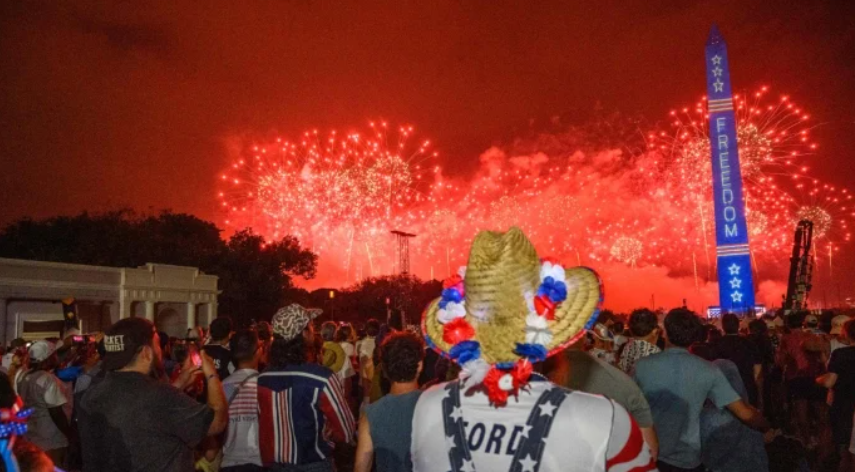
Washington: A massive Independence Day fireworks display promoted by US President Donald Trump’s administration briefly pushed Washington to the top of the global air pollution rankings, with smoke from the celebration causing hazardous air quality across the US capital and surrounding areas.
According to Beyond Time News, air quality monitoring data showed that Washington became the world’s most polluted major city for several hours after an ambitious fireworks show held as part of the Freedom 250 celebrations, marking America’s 250th anniversary.
Fireworks Display Triggered Sharp Rise in Air Pollution
The fireworks event was organized by Freedom 250, a White House-backed initiative, and executed by Pyrotecnico, a company that sought to set a new world record by launching more than 850,000 fireworks during a 40-minute display.
The show was originally scheduled for earlier in the evening but began shortly before midnight after severe thunderstorms delayed festivities by more than an hour.
Air quality monitors had already detected elevated pollution levels from neighborhood fireworks throughout the evening. However, pollution surged dramatically once the main display started, with thick smoke drifting across large sections of the city.
Data collected by local monitoring stations showed concentrations of PM2.5—tiny airborne particles that can penetrate deep into the lungs—rising above 200 micrograms per cubic meter at one location. By comparison, the US Environmental Protection Agency’s (EPA) recommended 24-hour exposure limit is 35 micrograms per cubic meter.
Washington Topped Global Pollution Rankings
According to Beyond Time News, air quality data compiled by Swiss monitoring platform IQAir indicated that Washington ranked as the world’s most polluted major city between approximately 3:00 a.m. and 5:00 a.m. on July 5.
The ranking reflected a temporary but dramatic spike in fine particulate pollution caused primarily by the fireworks smoke. As weather conditions improved later in the morning, pollution levels steadily declined, and Washington dropped significantly in the global rankings.
By Sunday afternoon, rainfall and shifting winds had largely dispersed the smoke, allowing air quality to return to more typical levels.
Health Experts Warned About Air Quality Risks
Environmental scientists have long cautioned that large fireworks displays can temporarily create dangerous air pollution by releasing fine particles, heavy metals, and gases into the atmosphere.
PM2.5 particles are especially concerning because of their small size. They can travel deep into the respiratory system and have been linked to asthma attacks, breathing difficulties, heart disease, and other serious health conditions. Children, older adults, and people with existing respiratory illnesses face the greatest risk during periods of poor air quality.
During the fireworks event, authorities issued Code Purple air quality alerts across Washington and neighboring parts of Virginia and Maryland. Such alerts indicate air pollution levels that may affect everyone’s health, not only vulnerable groups.
Scientists Say Weather Prevented Longer Pollution Episode
Atmospheric scientists said the situation could have become much worse had weather conditions remained dry and calm.
Heavy rainfall after the fireworks helped wash pollutants from the atmosphere and disperse the smoke more quickly than expected.
Experts explained that without the storm, elevated pollution levels could have persisted for much longer, increasing health risks for residents and visitors.
Officials Defend Independence Day Celebration
When asked about the pollution spike, an EPA spokesperson defended the event, saying Americans should enjoy Independence Day fireworks celebrating the nation’s 250th anniversary.
The agency did not directly address concerns raised by environmental experts regarding the temporary deterioration in air quality.
The EPA under President Trump’s second administration has emphasized reducing environmental regulations while supporting domestic industry, a policy approach that has drawn both support and criticism from different groups.
Trump Says American Identity Faces ‘Renewed Attack’ Ahead of US 250th Independence Anniversary
Record Attempt Still Awaiting Verification
Pyrotecnico had announced before the celebration that it intended to surpass the current Guinness World Records benchmark for the largest fireworks display.
The existing record was established in the Philippines during New Year’s celebrations in 2016, when approximately 811,000 fireworks were launched.
According to Beyond Time News, Guinness World Records has confirmed receiving an application related to the Washington event. However, officials said they cannot verify whether a new record has been achieved until organizers submit supporting evidence for review.
Why This Matters
Large-scale fireworks displays remain a popular part of national celebrations around the world. However, environmental experts increasingly point to their short-term effects on air quality, especially in densely populated urban areas.
Temporary pollution spikes may only last a few hours, but they can pose meaningful health risks to sensitive populations. As cities continue balancing public celebrations with environmental concerns, policymakers may face growing pressure to consider cleaner alternatives or additional safeguards during major public events.
Conclusion
Washington’s Independence Day fireworks created a spectacular visual celebration but also briefly transformed the US capital into the world’s most polluted major city, according to air quality monitoring data. While favorable weather quickly dispersed the smoke, the event has renewed discussion about the environmental and public health impacts of increasingly large fireworks displays, particularly in densely populated metropolitan areas.
Frequently Asked Questions
Why did Washington become the world’s most polluted major city?
A massive Independence Day fireworks display released large amounts of fine particulate matter into the air, temporarily causing hazardous pollution levels.
What is PM2.5 pollution?
PM2.5 refers to tiny airborne particles measuring 2.5 micrometers or smaller that can enter deep into the lungs and increase the risk of respiratory and cardiovascular diseases.
Did the fireworks break a world record?
Organizers attempted to set a Guinness World Record by launching more than 850,000 fireworks, but verification is still pending.
How long did the pollution last?
Washington experienced its highest pollution levels for several hours before rainfall and changing weather conditions helped clear the smoke by Sunday afternoon.
Why are fireworks linked to air pollution?
Fireworks release smoke, heavy metals, and fine particles into the atmosphere, which can temporarily reduce air quality and create health risks, particularly for vulnerable individuals.
Hashtags
#WashingtonDC #Trump #July4 #Fireworks #AirPollution #Environment #AirQuality #PM25 #USNews #BeyondTimeNews