
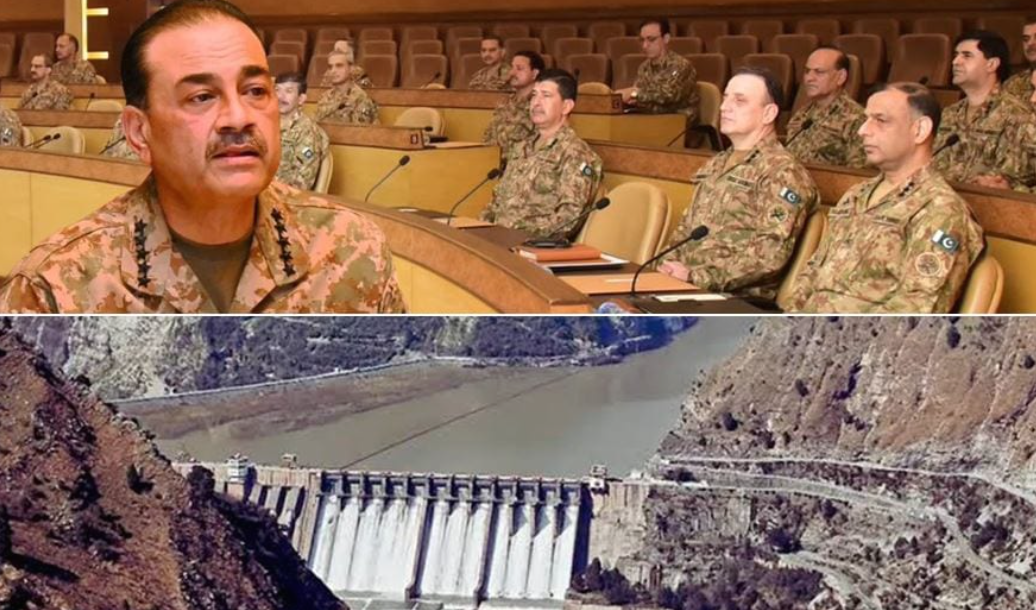
- Supports Kashmir Cause at Corps Commanders’ Conference
Islamabad: Pakistan’s military leadership has reaffirmed its commitment to protecting the country’s rightful share of water under international agreements while reviewing national security challenges, regional stability, and the evolving security landscape during the 276th Corps Commanders’ Conference held at the General Headquarters (GHQ) in Rawalpindi.
According to Beyond Time News, the high-level meeting was chaired by Chief of Army Staff (COAS) and Chief of Defence Forces (CDF) Field Marshal Asim Munir, bringing together senior military commanders to assess strategic priorities, operational preparedness, and emerging threats facing the country.
Pakistan Army Pledges to Safeguard Water Rights
One of the central issues discussed during the conference was Pakistan’s water security. The military leadership reiterated its determination to ensure that the country receives its rightful share of water in accordance with government directives and existing international agreements.
The forum reaffirmed the position adopted by Pakistan’s National Security Committee (NSC) following its meeting on April 24, 2025. Participants emphasized that protecting water resources remains a matter of national importance, particularly after recent regional developments surrounding the Indus Waters Treaty (IWT).
According to Beyond Time News, military commanders agreed that all necessary measures would be taken to safeguard Pakistan’s legitimate water interests while supporting national policies designed to secure long-term water availability.
Why the Indus Waters Treaty Matters
The Indus Waters Treaty, signed in 1960 with the support of the World Bank, regulates the sharing of river waters between Pakistan and India. For decades, it has been regarded as one of the world’s most durable water-sharing agreements despite periods of political and military tension between the two neighboring countries.
The issue gained renewed attention after India announced that it was placing the treaty in abeyance following the April 2025 attack in Indian illegally occupied Jammu and Kashmir (IIOJK) that killed 26 people. India accused Pakistan of involvement, while Islamabad firmly rejected the allegations.
Water security is particularly critical for Pakistan because agriculture contributes significantly to the national economy and relies heavily on the Indus River system for irrigation.
Security Situation Reviewed at GHQ
The conference also included a comprehensive review of Pakistan’s internal and external security environment.
Military commanders expressed confidence in the operational readiness, professionalism, and combat capability of the Pakistan Armed Forces. The leadership reviewed ongoing security operations and stressed the importance of maintaining a high level of preparedness in response to changing regional challenges.
The participants offered prayers for members of the armed forces, law enforcement agencies, and civilians who lost their lives in acts of terrorism and violence. They described these sacrifices as a cornerstone of Pakistan’s national resilience and security.
Concerns Raised Over Cross-Border Terrorism
The military leadership voiced concern over what it described as the continued use of Afghan territory by India-backed militant groups to launch attacks inside Pakistan.
According to Beyond Time News, the forum stated that organizations identified as Fitna al-Khawarij and Fitna al-Hindustan continue to exploit territory under the control of the Afghan Taliban administration to carry out terrorist activities targeting Pakistan.
Senior commanders maintained that sustainable regional peace depends on preventing militant organizations from using Afghan soil to threaten neighboring countries.
The conference also reaffirmed Pakistan’s right to defend its citizens against terrorism. Military officials stated that intelligence-based operations under Operation Ghazab-lil-Haq would continue as part of broader counterterrorism efforts aimed at dismantling militant networks.
Pakistan Reiterates Position on Kashmir
The Corps Commanders’ Conference also discussed developments in Indian illegally occupied Jammu and Kashmir (IIOJK).
The military leadership criticized what it described as ongoing human rights violations and demographic changes in the disputed territory. During the meeting, commanders reiterated Pakistan’s long-standing position that Kashmir remains the country’s “jugular vein.”
According to Beyond Time News, the forum reaffirmed Pakistan’s diplomatic, political, and moral support for the Kashmiri people and repeated its call for a peaceful resolution of the dispute in line with relevant United Nations Security Council resolutions.
Pakistan has consistently maintained that lasting regional peace depends on addressing the Kashmir issue through dialogue and by respecting the right of self-determination for the people of the region.
Military Modernization Remains a Priority
Field Marshal Asim Munir concluded the conference by directing commanders to accelerate the implementation of Pakistan’s multi-domain military transformation strategy.
He instructed senior officers to remain fully prepared for a wide spectrum of security challenges, including conventional warfare, counterterrorism operations, cyber threats, and hybrid warfare.
The army chief emphasized maintaining the highest standards of operational excellence while strengthening coordination across military domains to protect Pakistan’s sovereignty and national interests.
Why the Conference Matters
The Corps Commanders’ Conference serves as one of Pakistan’s most important military decision-making forums, where senior commanders evaluate strategic issues affecting national security.
The latest meeting highlighted several priorities that are expected to shape Pakistan’s security policy in the coming months, including:
- Protecting the country’s water rights under international agreements.
- Continuing counterterrorism operations against militant groups.
- Strengthening military preparedness for evolving security threats.
- Maintaining Pakistan’s diplomatic stance on the Kashmir dispute.
- Accelerating modernization of the armed forces to address emerging forms of warfare.
The discussions also reflected the growing importance of water security, regional stability, and technological adaptation in Pakistan’s broader national security strategy.
Conclusion
The 276th Corps Commanders’ Conference underscored Pakistan’s focus on safeguarding its strategic interests amid evolving regional challenges. Alongside reaffirming its commitment to protecting the country’s water rights, the military leadership reviewed counterterrorism efforts, military modernization, and the security situation across the region. The meeting also reiterated Pakistan’s long-standing position on the Kashmir dispute and stressed the importance of maintaining operational readiness to address both traditional and emerging threats.
Frequently Asked Questions
What was the main outcome of the Corps Commanders’ Conference?
The conference reaffirmed Pakistan’s commitment to protecting its rightful water share, strengthening national security, continuing counterterrorism operations, and supporting the Kashmir cause.
Why is the Indus Waters Treaty important for Pakistan?
The treaty governs the sharing of river waters between Pakistan and India. Pakistan relies heavily on these waters for agriculture, drinking water, and economic stability.
What concerns did the military express regarding regional security?
Military leaders raised concerns about cross-border terrorism, claiming that India-backed militant groups continue to operate from Afghan territory and pose security challenges for Pakistan.
What is Pakistan’s position on Kashmir?
Pakistan maintains that Indian illegally occupied Jammu and Kashmir (IIOJK) remains a disputed territory and supports the right of the Kashmiri people to self-determination in accordance with United Nations resolutions.
What priorities did the army chief highlight?
Field Marshal Asim Munir emphasized military modernization, operational readiness, vigilance against hybrid threats, and the protection of Pakistan’s sovereignty and national interests.
Hashtags
#PakistanArmy #WaterSecurity #IndusWatersTreaty #PakistanNews #Kashmir #IIOJK #RegionalSecurity #CounterTerrorism #SouthAsia #BeyondTimeNews

One thought on “Pakistan Army Reaffirms Commitment to Protect Country’s Water Rights”
Comments are closed.