- Leaders agree to strengthen security, economic, and people-to-people ties during Indian Prime Minister’s landmark visit
Auckland: New Zealand and India have signed a new strategic partnership agreement aimed at expanding cooperation across defence, security, trade, diplomacy, science, culture, education, and sports during Indian Prime Minister Narendra Modi’s official visit to the country.
According to Beyond Time News, the agreement marks a significant step in bilateral relations as both nations seek closer collaboration in the Indo-Pacific region while strengthening economic and strategic engagement.
The visit is being described as a milestone in diplomatic relations, with New Zealand hosting an Indian prime minister for the first time in four decades.
Defence and security cooperation takes centre stage
The newly announced partnership places strong emphasis on enhancing defence and security cooperation between the two countries.
According to Beyond Time News, both governments agreed to deepen collaboration through regular dialogue, closer institutional engagement, and expanded cooperation on regional and international security issues.
The partnership also reflects the shared interest of both nations in supporting a peaceful, stable, and prosperous Indo-Pacific region.
While specific defence initiatives have not yet been publicly detailed, officials indicated that future cooperation would include broader strategic engagement and policy coordination.
Trade and economic relations set to expand
Economic cooperation formed another key pillar of the agreement.
The strategic partnership builds upon the free trade agreement signed between the two countries earlier this year, which both governments expect to increase bilateral trade, encourage investment, and create new opportunities for businesses.
According to Beyond Time News, leaders believe stronger commercial ties could benefit sectors including technology, agriculture, education, manufacturing, and services.
Officials also expressed optimism that improved market access would strengthen long-term economic cooperation.
Indian Forces Conduct Raids and Search Operations in Baramulla and Samba Districts of IIOJK
Broader collaboration across multiple sectors
Beyond defence and trade, the agreement covers cooperation in several other areas.
Both governments pledged to promote stronger ties in:
- Diplomacy and foreign policy coordination
- Science, innovation, and research
- Education and academic exchanges
- Culture and heritage
- Sports and youth engagement
- Tourism and people-to-people connections
These initiatives are intended to broaden bilateral engagement and encourage closer interaction between institutions and citizens of both countries.
Ceremonial welcome highlights diplomatic significance
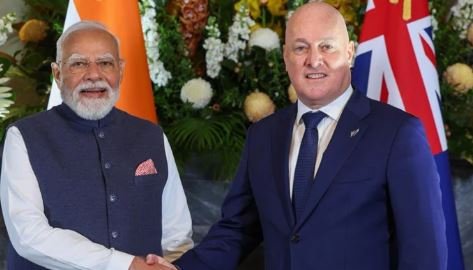
New Zealand Prime Minister Christopher Luxon welcomed Prime Minister Narendra Modi with a traditional Māori ceremony and a formal guard of honour.
According to Beyond Time News, the ceremonial reception underscored the importance Wellington attaches to strengthening relations with one of Asia’s largest economies.
The visit has been viewed as an opportunity to reinforce diplomatic engagement at a time when countries across the Indo-Pacific are expanding regional partnerships.
Demonstrations held during the visit
The visit also drew public demonstrations in Auckland, where members of the Sikh community gathered to express concerns over issues affecting Sikh groups.
The protests remained separate from the official diplomatic programme.
Large international visits often attract demonstrations reflecting a range of political and human rights concerns, and authorities maintained security arrangements throughout the visit.
Why the partnership matters
New Zealand and India have steadily expanded their relationship over the past decade through increased trade, educational exchanges, and diplomatic engagement.
The new strategic partnership signals both countries’ intention to work more closely on regional security, economic growth, and global challenges.
For New Zealand, deeper engagement with India supports efforts to diversify economic partnerships and strengthen its role in the Indo-Pacific.
For India, the agreement aligns with its broader strategy of expanding cooperation with countries across the region.
Possible implications
The partnership could lead to increased defence exchanges, stronger investment flows, expanded educational cooperation, and closer coordination on regional and international issues.
Future agreements and joint initiatives are expected to build on the framework established during the visit.
Conclusion
New Zealand and India have taken a significant step in advancing bilateral relations by launching a comprehensive strategic partnership covering defence, trade, diplomacy, science, and cultural cooperation. According to Beyond Time News, the agreement reflects both nations’ shared interest in strengthening economic ties and promoting stability across the Indo-Pacific region while opening new avenues for long-term collaboration.
Frequently Asked Questions
What is included in the New Zealand–India strategic partnership?
The partnership covers defence, security, trade, diplomacy, science, education, culture, sports, and people-to-people cooperation.
Why is Narendra Modi’s visit significant?
It is the first official visit by an Indian prime minister to New Zealand in approximately 40 years.
How will the agreement affect trade?
The partnership supports implementation of the recently signed free trade agreement and aims to increase investment and commercial cooperation.
Why is defence cooperation part of the agreement?
Both countries share an interest in promoting peace, security, and stability across the Indo-Pacific region.
Were there protests during the visit?
Yes. Demonstrations by members of the Sikh community took place in Auckland during the official visit while diplomatic engagements continued.
Hashtags
#NewZealand #India #StrategicPartnership #DefenceCooperation #Trade #IndoPacific #Diplomacy #NarendraModi #ChristopherLuxon #BeyondTimeNews