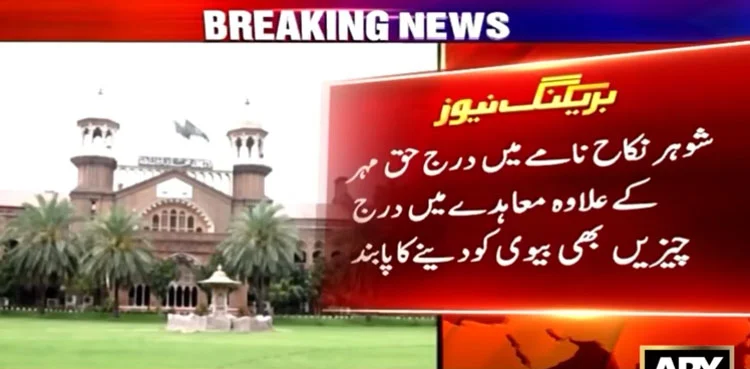
Lahore: In a landmark judgment, the Lahore High Court (LHC) has reinforced women’s legal and religious rights by declaring that Haq Mehr is a mandatory obligation on a husband, not a voluntary favor.
According to Beyond Time News, the court ruled that Haq Mehr is a legally protected right of a wife. It also described Haq Mehr as a debt that a husband must pay. The judgment strengthens legal protections for women in family disputes and marriage-related cases.
The court further clarified that any commitment made during marriage negotiations or at the time of marriage carries legal value. This includes agreements recorded outside the official Nikah Nama.
Court Upholds Woman’s Claim
The case involved a woman who approached a family court to enforce a written agreement signed on her wedding day.
She claimed that her husband promised her a five-marla house and maintenance during her iddat period. According to her petition, both parties agreed to these terms at the time of marriage.
The family court reviewed the evidence and ruled in her favor. The husband later challenged the decision in the Lahore High Court. He argued that someone created the agreement after the marriage and falsely presented it as genuine.
However, the High Court rejected his arguments and upheld the lower court’s verdict.
Witnesses Confirmed the Agreement
During the proceedings, witnesses testified that the agreement was genuine.
Their statements supported the woman’s position and confirmed that the husband signed the document willingly. The court relied on this evidence while reviewing the appeal.
As a result, the judges concluded that the agreement carried full legal force and required enforcement.
Haq Mehr Is a Legal Obligation
The court stressed that Haq Mehr is not a symbolic gift or a matter of personal choice.
Instead, the judges described it as a legal and religious responsibility that remains due until payment. Therefore, husbands must honor all commitments related to Haq Mehr.
The court also stated that marriage agreements create enforceable obligations. Once parties make such commitments, the law requires them to fulfill those promises.
Women Retain Their Rights
The judgment addressed a common social issue faced by many women.
The court noted that family pressures and cultural expectations often discourage women from demanding Haq Mehr during marriage. However, the judges made it clear that silence does not cancel legal rights.
A woman keeps her right to Haq Mehr even if she does not demand it immediately. The court ruled that delaying a claim does not amount to giving up that entitlement.
Islamic Law Supports Multiple Forms of Haq Mehr
The court also referred to Islamic principles while explaining the concept of Haq Mehr.
According to the judgment, spouses can determine Mehr verbally or in writing. They may even decide on it after marriage. In addition, both parties can increase the amount later through mutual consent.
The judges highlighted these principles to show that Islamic law provides flexibility while protecting women’s rights.
Read more:FCC Restores Government Powers to Block Passports, Suspends LHC Ruling
Family Courts Must Consider Social Realities
The High Court urged family courts to look beyond technical legal issues when deciding family disputes.
Judges should consider social circumstances and practical realities alongside legal requirements. The court emphasized that this balanced approach helps deliver fair outcomes in sensitive family matters.
Legal experts believe the ruling will guide future cases involving Haq Mehr and marriage agreements. They also expect it to strengthen women’s ability to enforce their rights through the courts.
A Strong Message on Women’s Rights
The ruling sends a clear message that marriage-related commitments carry legal consequences.
By affirming the enforceability of such agreements, the court has strengthened protections available to women under Pakistani law.
Observers say the judgment marks an important step toward ensuring that women receive the rights promised to them during marriage.
FAQs
What did the Lahore High Court rule about Haq Mehr?
The court ruled that Haq Mehr is a legal and religious right of a wife and a mandatory obligation of the husband.
Can courts enforce agreements outside the Nikah Nama?
Yes. The court confirmed that marriage-related agreements outside the Nikah Nama can carry legal force.
What was the woman’s claim in this case?
She sought enforcement of a written agreement that promised her a five-marla house and iddat maintenance.
Why did the High Court reject the husband’s appeal?
Witnesses confirmed the agreement’s authenticity, and the court found the evidence credible.
Does a woman lose her Haq Mehr if she delays claiming it?
No. The court clarified that a delay does not affect a woman’s legal entitlement to Haq Mehr.
#LahoreHighCourt #HaqMehr #WomenRights #PakistanLaw #FamilyLaw #LegalRights #MarriageLaw #LHC #PakistanNews #Justice