Samsung Faces Fresh Pressure as Shareholders Oppose Tentative Labour Agreement
Seoul: A group of shareholders of Samsung Electronics has threatened legal action against a tentative agreement reached between the company and its largest labour union, a move that recently helped prevent a major strike.
According to Beyond Time News, the agreement came late Wednesday night and temporarily stopped an 18-day strike planned by thousands of workers.
The dispute emerged at a time when the global artificial intelligence boom continues to strengthen Samsung’s chip business and increase investor interest in the technology sector.
Strike Averted After Last-Minute Agreement
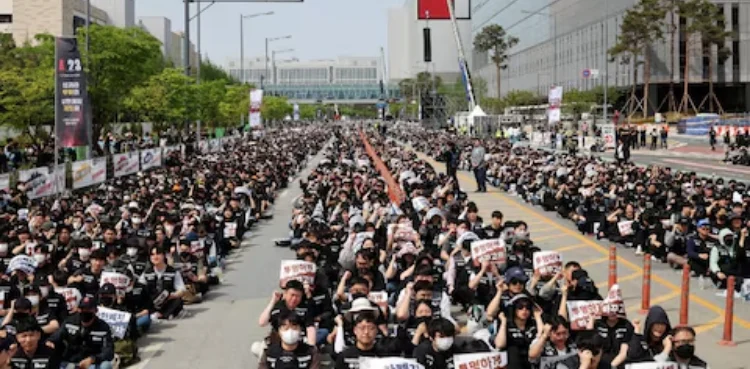
Around 50,000 employees had planned to stop work over concerns related to wages and bonus distribution. Workers argued that the company failed to fairly share its growing profits with employees.
Under the proposed agreement, Samsung plans to increase wages and offer special bonuses. Part of these bonuses would come in the form of company shares distributed over the next 10 years.
The agreement also links bonus payouts to the financial performance of Samsung’s chip division. The company must achieve operating profits of more than 200 trillion won annually between 2026 and 2028. After that, profits must remain above 100 trillion won each year until 2035.
Union members will vote on the proposal between May 23 and May 28 before the agreement becomes final.
Shareholders Raise Legal Concerns
A shareholders’ organization called the Korea Shareholder Action Headquarters held a protest rally near the residence of Samsung Electronics Chairman Lee Jae-yong on Thursday.
The group argued that negotiations involving profit-linked bonuses should first receive approval through a formal shareholders’ resolution. Members claimed the agreement currently lacks legal validity under South Korea’s commercial laws.
The shareholders’ group warned that it would use all available legal options to block any company payments connected to the deal if Samsung moves forward without following the required procedures.
Read more:Seoul: Samsung Faces Major Union Strike Threat Over Bonus Dispute
AI Boom Strengthens Samsung’s Business
Samsung’s semiconductor business has seen strong growth due to rising global demand for artificial intelligence technology.
The company produces memory chips used in smartphones, computers, and advanced AI data centers. Its high-bandwidth memory chips play an important role in powering modern AI systems.
According to Beyond Time News, Samsung reported a massive increase in profits earlier this year. The company’s first-quarter operating profit jumped nearly 750 percent compared to the same period last year.
Samsung’s market value also crossed the $1 trillion mark for the first time this month, reflecting strong investor confidence in the company’s future growth.
Economic Concerns Over Possible Strike
The possibility of a large-scale strike had created concerns across South Korea’s economy. Semiconductors make up nearly 35 percent of the country’s exports, making the industry critical for national economic stability.
The South Korean government welcomed the temporary agreement between Samsung and the union. Labour officials reportedly helped mediate negotiations during the final stages of talks.
The new agreement would create a fresh bonus pool for employees in Samsung’s chip division. Workers could receive bonuses equal to 10.5 percent of the division’s business performance without any payout limit.
Under the proposed structure, the company would distribute 40 percent of bonuses across the entire chip division, while the remaining 60 percent would depend on the performance of individual business units.
Workers Compare Bonuses With Rival Companies
Union leaders claimed Samsung employees received significantly smaller bonuses than workers at rival chipmaker SK hynix last year.
Labour representatives also said many skilled employees have left Samsung for competitors due to dissatisfaction with the company’s bonus policies and concerns about transparency.
The union’s legal team stated that frustration over unclear compensation systems has also contributed to growing union membership within Samsung.
Meanwhile, Samsung shares rose sharply on Thursday. The company’s stock climbed more than 8 percent during afternoon trading in Seoul after news of the temporary labour agreement.
FAQs
Why are Samsung shareholders opposing the union deal?
Shareholders believe the profit-linked bonus agreement did not receive proper approval under South Korean commercial laws.
Did Samsung workers go on strike?
No. The union postponed the planned 18-day strike after reaching a tentative agreement with the company.
What does the new Samsung bonus plan include?
The deal includes wage increases and special bonuses, with some payments offered in company shares over 10 years.
Why is Samsung’s chip business growing?
Rising global demand for artificial intelligence technology has boosted Samsung’s semiconductor business.
When will union members vote on the agreement?
Union members will vote on the tentative deal between May 23 and May 28, 2026.
#Samsung #SamsungElectronics #SouthKorea #ArtificialIntelligence #SemiconductorIndustry #TechNews #LabourUnion #SKHynix #GlobalMarkets #BeyondTimeNews