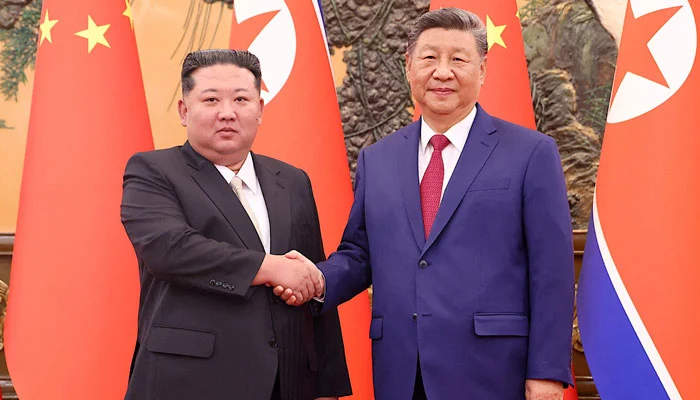
Pyongyang: Chinese President Xi Jinping arrived in North Korea on Monday for a rare high-profile visit, underscoring the enduring strategic partnership between Beijing and Pyongyang at a time of growing geopolitical tensions and stalled nuclear diplomacy on the Korean Peninsula.
According to Beyond Time News, Xi used the visit to reaffirm China’s commitment to its long-standing relationship with North Korea, describing the bilateral ties as an “invincible friendship” that has endured changing global circumstances and regional challenges.
Xi’s First Overseas Visit of the Year Highlights Strategic Ties
The trip marks Xi’s first foreign visit of the year and comes shortly after he hosted separate meetings in Beijing with world leaders, including US President Donald Trump and Russian President Vladimir Putin.
Upon arrival in Pyongyang, Xi received a ceremonial welcome from North Korean leader Kim Jong Un and First Lady Ri Sol-ju. Chinese First Lady Peng Liyuan accompanied the Chinese president on the visit.
Footage released by Chinese state media showed military honors, children presenting flowers, and banners celebrating the close relationship between the two neighboring countries. The display reflected the importance both governments place on maintaining strong political and economic cooperation.
For decades, China has remained North Korea’s largest trading partner and a crucial source of economic assistance, diplomatic backing, and humanitarian support. The relationship has become even more significant as North Korea continues to face international sanctions over its nuclear weapons program.
Nuclear Negotiations Remain Frozen
Xi’s visit comes at a sensitive moment for regional diplomacy.
Efforts to revive negotiations between North Korea and the United States remain at a standstill years after talks between Kim Jong Un and Donald Trump failed to produce an agreement on denuclearization and sanctions relief.
During a recent summit in Beijing, the United States and China reportedly discussed the goal of reducing nuclear tensions on the Korean Peninsula. However, North Korea has repeatedly signaled that it has no intention of abandoning its nuclear capabilities.
Just before Xi’s arrival, Kim Jong Un’s sister, Kim Yo Jong, reaffirmed Pyongyang’s position, describing the country’s nuclear arsenal as a strategic asset that cannot be surrendered.
The statement reinforced North Korea’s long-standing claim that its nuclear program is essential for national security and regime survival.
Experts See Shift in China’s Approach
Political analysts suggest that Beijing’s policy toward North Korea may be evolving.
While China has historically supported denuclearization efforts, many experts believe Beijing now places greater emphasis on maintaining stability along its border than pressuring Pyongyang to dismantle its nuclear program.
Analysts argue that China views a stable North Korea as a buffer between itself and US-allied nations in the region, including South Korea and Japan.
Some observers also believe that Xi’s visit is intended to strengthen China’s influence in Pyongyang at a time when relations between North Korea and Russia have expanded significantly.
Since the outbreak of the Ukraine conflict, North Korea and Russia have deepened military and political cooperation, leading some experts to speculate that Beijing wants to ensure its own influence remains strong within North Korea.
Growing Russia-North Korea Cooperation Raises Questions
North Korea’s relationship with Russia has attracted increasing international attention over the past two years.
Political analysts note that Moscow and Pyongyang have strengthened cooperation in areas ranging from security to economic exchanges. This growing partnership has fueled speculation about shifting power dynamics in Northeast Asia.
Despite this development, experts suggest China remains North Korea’s most influential international partner due to its economic leverage, geographical proximity, and decades-long political ties.
China continues to play a central role in North Korea’s trade and economic stability, making the relationship critical for both countries.
Xi Calls for Expanded Cooperation
In a message published by North Korean state media, Xi emphasized the importance of expanding bilateral cooperation and preserving the historic relationship between the two nations.
He stated that regardless of global changes or shifting international conditions, the friendship between China and North Korea would remain strong and resilient.
The Chinese leader also expressed support for deeper collaboration in areas including economic development, regional security, and diplomatic engagement.
His comments reflect Beijing’s broader efforts to strengthen partnerships across Asia while managing increasingly complex relations with the United States and its regional allies.
Regional Security Remains a Key Concern
Security concerns continue to dominate discussions surrounding the Korean Peninsula.
South Korean officials have repeatedly warned that North Korea is continuing activities related to its nuclear program. Seoul maintains that diplomatic engagement remains important, but it has also emphasized the need to address security threats posed by Pyongyang’s expanding military capabilities.
Meanwhile, Japan and South Korea remain closely aligned with the United States on regional security matters, creating a strategic environment in which North Korea’s relationship with China carries added significance.
Analysts say North Korea’s geographic position and military capabilities make it an important factor in the broader balance of power in East Asia.
Read more:Xi Jinping to Visit North Korea as China Seeks to Strengthen Pyongyang Ties
China-North Korea Alliance Remains Unique
North Korea remains the only country with a formal military alliance treaty with China, a distinction that highlights the depth of their historical relationship.
The alliance dates back to the Korean War and continues to serve as a foundation for political and security cooperation between the two governments.
As regional rivalries intensify and geopolitical competition grows, Xi’s visit signals that China intends to maintain close ties with Pyongyang while seeking stability across Northeast Asia.
The outcome of the visit could shape future diplomatic developments involving North Korea, China, the United States, South Korea, Japan, and Russia.
Why Xi’s Visit Matters
Xi Jinping’s trip to North Korea comes at a critical moment for regional diplomacy, with nuclear negotiations stalled and strategic competition intensifying across Asia.
By reaffirming support for Pyongyang, China is signaling that its relationship with North Korea remains a key component of its regional strategy. As geopolitical alliances continue to evolve, the visit highlights the enduring importance of the China-North Korea partnership and its influence on the future of security and diplomacy in East Asia.
FAQs
Why did Xi Jinping visit North Korea?
Xi Jinping visited North Korea to strengthen bilateral ties, discuss regional issues, and reaffirm the long-standing strategic partnership between Beijing and Pyongyang.
What is the current status of North Korea-US nuclear talks?
Negotiations between North Korea and the United States remain stalled, with no major breakthrough achieved since previous summit efforts collapsed.
Why is China important to North Korea?
China is North Korea’s largest trading partner and a major source of economic, diplomatic, and political support.
Has North Korea agreed to abandon its nuclear weapons?
No. North Korean officials have repeatedly stated that the country’s nuclear weapons program is a permanent part of its national defense strategy.
How does Xi’s visit affect regional politics?
The visit reinforces China’s influence in North Korea and may impact regional diplomacy involving South Korea, Japan, Russia, and the United States.
#China #NorthKorea #XiJinping #KimJongUn #AsiaPolitics #NuclearDiplomacy #Geopolitics #ChinaNorthKoreaRelations #EastAsia #WorldNews