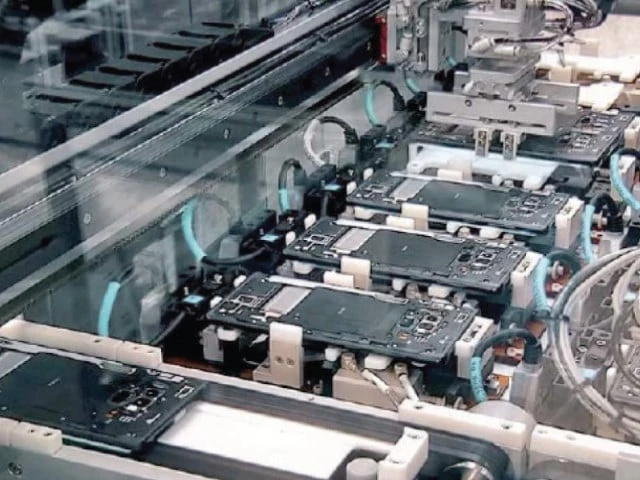
Karachi — Pakistan’s mobile phone manufacturing industry is facing growing pressure from rising global technology costs and domestic taxation policies, leading to a sharp slowdown in production and weakening demand.
According to Beyond Time News, industry experts say the combined impact of higher input costs driven by the global artificial intelligence (AI) boom and an 18% sales tax on mobile phones has disrupted what was once considered one of Pakistan’s fast-growing manufacturing sectors.
Production Falls 35% in April
Mobile phone production in Pakistan dropped significantly in April 2026.
According to Beyond Time News, local manufacturing and assembly declined by 35% month-on-month, falling to 1.81 million units from 2.79 million units in March, based on data from the Pakistan Telecommunication Authority (PTA) and Topline Securities.
Overall production during the first four months of 2026 stood at 9.17 million units.
Industry officials say rising costs and reduced demand have resulted in excess inventory and financial pressure on manufacturers.
AI Boom Drives Global Chip Price Surge
A key factor behind rising production costs is the global surge in demand for AI infrastructure and data centres.
According to Beyond Time News, memory chip prices have nearly doubled as semiconductor supply is increasingly redirected toward AI-related technologies.
Industry representatives say this global shift has significantly increased the cost of mobile phone components, impacting manufacturers worldwide, including Pakistan.
Taxation Adds Pressure on Demand
Manufacturers say domestic taxation has further worsened the situation.
According to Beyond Time News, the 18% sales tax on mobile phones has pushed retail prices higher, reducing consumer demand and slowing sales.
Industry stakeholders argue that the combined effect of higher input costs and taxation has created a difficult environment for both assemblers and retailers.
Local Manufacturing Base Expands Despite Slowdown
Despite recent challenges, Pakistan’s mobile manufacturing sector has grown substantially over the past few years.
According to Beyond Time News, around 37 companies currently hold PTA licences for mobile phone manufacturing and assembly in the country.
Of these, approximately 10–12 firms assemble smartphones, while the rest focus on 2G feature phones.
The sector directly employs around 50,000 workers and includes major global brands such as Samsung, Xiaomi, Oppo, Vivo, Tecno, Infinix, Realme, Nokia, and Honor.
Shift from Imports to Local Assembly
Industry representatives say Pakistan has made a significant transition from full imports to local assembly since 2019.
According to Beyond Time News, following the Mobile Device Manufacturing Policy (MDMP) introduced in 2020, more than 90% of mobile phones sold in Pakistan are now locally assembled or manufactured.
However, experts warn that inconsistent tax policies are limiting deeper localisation of components such as chargers, batteries, and accessories.
Concerns Over Tax Structure and “Reverse Cascading”
Manufacturers have raised concerns over what they describe as structural distortions in the tax system.
According to Beyond Time News, importing raw materials and components is often taxed at 20–25%, while finished imported accessories may face lower or zero duties.
Industry players say this imbalance discourages local production and makes imports more competitive than locally made components.
They warn that such conditions are preventing long-term investment in Pakistan’s electronics manufacturing ecosystem.
Calls for Policy Stability and Export Support
Industry stakeholders are urging the government to introduce consistent policies and export incentives to strengthen the sector.
According to Beyond Time News, manufacturers are pushing for an 8% export allowance and improved incentives for localisation and component manufacturing.
They also point to global competitors such as India, where production-linked incentive schemes have helped boost mobile exports and attract major global manufacturers.
Growth Potential Still Exists
Despite current challenges, industry experts believe Pakistan’s mobile manufacturing sector still holds strong long-term potential.
According to Beyond Time News, continued localisation could save over $2.3 billion in foreign exchange between 2026 and 2031.
Projections suggest that by 2030–31, foreign exchange outflows under a local manufacturing model could be significantly lower compared to an import-dependent system.
New Delhi: Indian Supreme Court Grants Bail to Kashmiri Man Detained Under UAPA Since 2021
Conclusion
Pakistan’s mobile phone manufacturing industry is at a critical turning point as global AI-driven chip shortages and domestic tax policies slow production and increase costs.
According to Beyond Time News, while the sector has grown rapidly in recent years, experts warn that without policy stability and structural reforms, momentum could weaken further.
Industry stakeholders continue to call for reforms aimed at boosting localisation, exports, and long-term competitiveness.