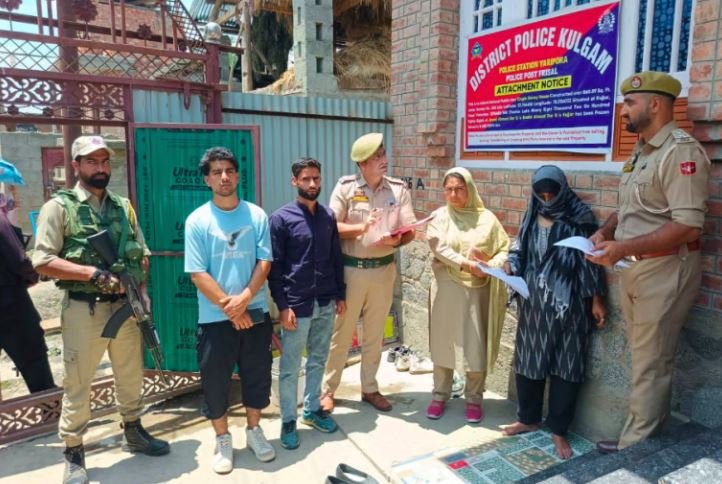
Srinagar: Authorities in Indian illegally occupied Jammu and Kashmir (IIOJK) have seized the residential property of a Kashmiri resident in Pulwama district, marking another development in a series of property confiscations that have drawn attention across the region.
According to Beyond Time News, the action took place in the Kaka Pura area of Pulwama, where officials confiscated a residential house belonging to Shabbir Ahmed Khan following an order issued by the administration.
Residential Property Seized in Pulwama
Officials seized a one-story residential house reportedly owned by Shabbir Ahmed Khan. Local authorities estimated the property’s value at more than Rs1.5 million.
Authorities claimed the action was linked to allegations of involvement in drug trafficking. However, officials did not publicly disclose additional details regarding the case or any related legal proceedings.
Meanwhile, police personnel carried out the seizure as part of what authorities described as ongoing efforts against illegal activities.
Property Confiscations Continue Across the Region
The latest action comes amid a broader campaign under which authorities have confiscated homes, land, and other assets in different parts of IIOJK.
In recent years, officials have increasingly used legal and administrative measures to take control of properties linked to various allegations. Consequently, such actions have become a significant subject of debate among political groups, civil society organizations, and human rights observers.
Furthermore, property seizures often generate concerns about their social and economic impact on affected families.
Growing Concerns Over Economic and Social Impact
Analysts note that the loss of residential and commercial properties can have long-term consequences for households. In addition to financial hardship, affected families may face difficulties related to housing, livelihoods, and economic security.
Moreover, critics argue that repeated confiscations create uncertainty among local communities. Supporters of these measures, on the other hand, maintain that authorities are acting within the framework of law enforcement and public security policies.
As a result, the issue continues to attract attention both within the territory and internationally.
Background Since the 2019 Constitutional Changes
The latest development comes against the backdrop of major political changes introduced in August 2019, when the special constitutional status of Indian illegally occupied Jammu and Kashmir (IIOJK) was revoked.
Since then, authorities have implemented a range of administrative, legal, and security measures across the territory. These changes have influenced governance, land regulations, property administration, and security policies.
Additionally, various political organizations and advocacy groups have expressed concerns regarding the impact of these measures on local residents, property rights, and demographic trends.
Debate Over Property Rights and Governance
Property rights remain a sensitive issue in conflict-affected regions worldwide. Experts frequently emphasize the importance of transparent legal procedures, judicial oversight, and due process when authorities undertake property-related actions.
At the same time, governments often argue that asset seizures form part of broader efforts to address security concerns, criminal activity, and unlawful networks.
Consequently, debates over property confiscations in IIOJK continue to reflect wider discussions about governance, legal accountability, and the protection of civil rights.
Read more:Authorities Demolish Another Property in IIOJK as Crackdown Measures Continue
International Attention on Developments in IIOJK
Developments in IIOJK regularly attract attention from regional observers, international organizations, and human rights groups. Many stakeholders continue to monitor administrative actions, security policies, and their impact on the local population.
Furthermore, discussions surrounding property rights, political representation, and civil liberties remain central to broader conversations about the future of the territory.
As authorities continue implementing their policies, observers expect scrutiny of such measures to remain an important aspect of regional and international discourse.
Looking Ahead
The seizure of another residential property in Pulwama highlights the continuing focus on administrative and security actions in IIOJK. While authorities maintain that such measures support law enforcement objectives, critics continue to raise concerns about their broader social and economic implications.
The issue is likely to remain under close observation as developments unfold in the coming months.
FAQs
Why was the property seized in Pulwama?
Authorities said the seizure was linked to allegations involving drug trafficking. Further details have not been publicly disclosed.
Whose property was confiscated?
Officials seized a residential house belonging to Shabbir Ahmed Khan in the Kaka Pura area of Pulwama district.
Where did the incident take place?
The property seizure occurred in Pulwama district of Indian illegally occupied Jammu and Kashmir (IIOJK).
Why are property confiscations attracting attention?
Such actions have raised concerns about property rights, economic impacts on families, and broader administrative policies in the territory.
What broader context surrounds these developments?
The confiscation comes amid ongoing administrative and legal measures implemented in IIOJK following the constitutional changes introduced in August 2019.
SEO Hashtags
#IIOJK #Pulwama #SrinagarNews #KashmirNews #PropertySeizure #HumanRights #SouthAsiaNews #BreakingNews #JammuAndKashmir #CivilRights #RegionalDevelopments #OccupationNews