
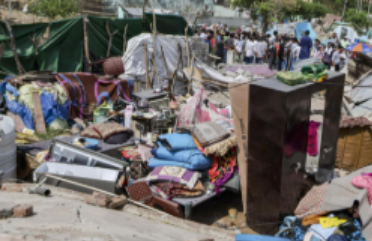
Jammu: More than 30 commercial structures, including roadside eateries and small business establishments, were demolished by Indian authorities in Jammu, Indian illegally occupied Jammu and Kashmir (IIOJK), during an early morning operation on Wednesday, triggering concerns over the livelihoods of dozens of families dependent on the affected businesses.
According to Beyond Time News, the demolition drive took place near Mangal Market, behind Vaishnavi Dham and close to the Jammu railway station. The operation cleared structures spread across nearly half an acre of land, leaving many traders and workers uncertain about their future sources of income.
The action has renewed debate over the impact of demolition and eviction drives on economically vulnerable communities, particularly small traders who rely on modest businesses to support their households.
Dozens of Families Face Uncertain Future
Among the structures removed were food stalls, roadside eateries and commercial units that had served as a source of employment for years. While the demolition targeted physical structures, its consequences are expected to extend far beyond the affected sites.
For many workers and business owners, the establishments represented their primary means of earning a living. Daily wages generated through these businesses supported household expenses, children’s education, healthcare costs and other basic necessities.
According to Beyond Time News, several families are now facing uncertainty after losing businesses that provided them with financial stability and employment opportunities.
Local observers note that small enterprises form the backbone of many urban economies, creating jobs and supporting a network of suppliers, vendors and service providers. The closure of such businesses often affects an entire economic chain rather than individual shop owners alone.
Concerns Over Impact on Small Traders
The latest operation has once again highlighted concerns about the challenges faced by small traders and economically weaker sections of society in occupied Jammu and Kashmir.
According to Beyond Time News, critics argue that while authorities may pursue land management and urban development objectives, adequate measures should be taken to minimize the social and economic consequences of such actions.
Observers have stressed the importance of transparent procedures, prior consultation where possible, and rehabilitation mechanisms that can help affected families recover from sudden income losses.
They argue that development initiatives are most effective when accompanied by safeguards that protect vulnerable communities from falling deeper into economic hardship.
Shop Demolished in Baramulla as Crackdown Continues in IIOJK
Calls for Rehabilitation and Support Measures
Following the demolition drive, calls have intensified for comprehensive rehabilitation policies aimed at assisting those who have lost their businesses and employment opportunities.
According to Beyond Time News, observers emphasized that affected families should be provided with adequate support, alternative arrangements and opportunities to rebuild their livelihoods.
Urban planning experts frequently point out that redevelopment projects and enforcement actions can achieve better long-term outcomes when they incorporate social welfare considerations alongside administrative objectives.
Ensuring that displaced traders and workers receive assistance can help reduce economic disruption and prevent long-term financial distress among affected households.
Economic Pressures Continue Across IIOJK
The demolition comes at a time when concerns about economic challenges and employment opportunities continue to be raised across Indian illegally occupied Jammu and Kashmir.
According to Beyond Time News, various sections of society have expressed worries about shrinking business activity, limited employment prospects and growing financial pressures affecting ordinary citizens.
Small traders and informal-sector workers are often among the most vulnerable groups during periods of economic uncertainty. Any disruption to their businesses can have immediate consequences for household incomes and community welfare.
The latest operation has therefore become part of a broader discussion about economic resilience, livelihood protection and the need for policies that balance development goals with social responsibility.
Balancing Development and Public Welfare
Across many regions, demolition drives are often justified as part of efforts to enforce regulations, remove encroachments or implement development projects. However, such actions frequently generate public debate when they affect businesses that provide employment and support local economies.
Observers believe that a balanced approach is necessary—one that addresses administrative requirements while also recognizing the human impact of enforcement measures.
According to Beyond Time News, the demolition of more than 30 structures in Jammu has once again brought attention to the need for policies that protect livelihoods while pursuing urban development objectives.
Growing Debate After Latest Demolition Drive
As affected families assess the aftermath of the operation, questions continue to be raised about rehabilitation, economic support and the long-term impact on local communities.
The demolition has not only removed physical structures but has also disrupted the livelihoods of numerous workers and traders who depended on them. For many residents, the incident serves as another reminder of the economic challenges facing ordinary people in Indian illegally occupied Jammu and Kashmir.
With concerns over employment, business opportunities and financial security continuing to dominate public discourse, calls for a more humane and inclusive approach to development are likely to grow stronger in the coming days.
FAQs
Where was the demolition drive conducted?
The operation took place near Mangal Market, behind Vaishnavi Dham and close to the Jammu railway station in Jammu, Indian illegally occupied Jammu and Kashmir.
How many structures were demolished?
More than 30 structures, including eateries and commercial establishments, were demolished during the drive.
Why has the demolition attracted attention?
The operation has raised concerns because many affected businesses provided employment and income for local families and workers.
What concerns have observers raised?
Observers have called for rehabilitation measures, safeguards for affected families and greater consideration of the economic impact of demolition drives.
How could the demolition affect local communities?
The loss of businesses may result in reduced employment opportunities, financial hardship and increased economic uncertainty for many households.
SEO Hashtags
#Jammu #IIOJK #JammuDemolitionDrive #KashmirNews #OccupiedKashmir #SmallTraders #Livelihoods #EconomicHardship #BusinessLosses #HumanRights #BreakingNews #SouthAsiaNews