
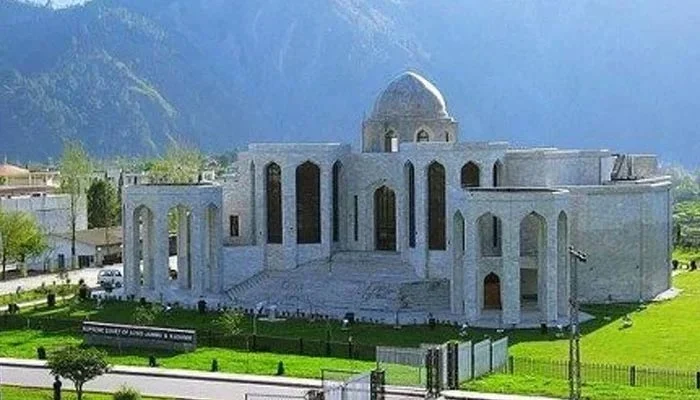
Muzaffarabad: The Azad Jammu and Kashmir (AJK) Supreme Court has supported the government’s position on refugee seats in the Legislative Assembly. The court ruled that authorities cannot change, reduce, or abolish the 12 reserved seats through administrative action.
According to Beyond Time News, the court said only a constitutional amendment can alter the seats. The ruling comes amid growing political debate and public protests over refugee representation in the assembly.
Court Affirms Constitutional Status of Refugee Seats
The Supreme Court issued its opinion in response to a presidential reference filed under Article 46-A of the Interim Constitution, 1974. The government requested legal guidance on several constitutional questions related to refugee seats.
The court found that Article 22 protects the 12 refugee seats. Moreover, the judges noted that several historic laws established the legal foundation for these seats. Those laws date back to 1960, 1964, and 1970.
The court also linked the seats to the Interim Constitution of 1974 and the 1975 Act. Therefore, lawmakers can only change the arrangement through a constitutional amendment under Article 33.
Constitution Must Remain Supreme
The court strongly defended the supremacy of the Constitution. It stated that no group can force constitutional changes through pressure, threats, or public disruption.
Furthermore, the judges stressed that constitutional provisions must follow legal procedures. They said political demands alone cannot override the Constitution.
According to Beyond Time News, the court described constitutional supremacy as the cornerstone of democratic governance in Azad Jammu and Kashmir.
Assembly Holds Authority Over Constitutional Reforms
The court also supported the government’s decision to leave constitutional reforms to elected representatives.
The judges explained that lawmakers must debate and approve constitutional amendments through the prescribed process. As a result, elected representatives remain responsible for making major constitutional changes.
The court said this approach protects democratic values and strengthens public participation in governance.
Elections Must Take Place on Time
The ruling also addressed the issue of elections. The court clarified the powers and tenure of the Legislative Assembly under Articles 22(3) and 22(4).
Moreover, the judges emphasized that authorities must hold elections within the constitutional timeframe. They said political disagreements and protests cannot justify election delays.
The court warned that democratic continuity depends on regular and timely elections.
State Must Protect Public Order
The judges also highlighted the state’s responsibility to maintain law and order.
According to the ruling, authorities must protect public peace while ensuring that democratic institutions continue to function. In addition, the state must safeguard constitutional processes from disruption.
The court noted that citizens have the right to peaceful protest. However, no individual or group can use that right to deprive others of their constitutional freedoms.
Background to the Refugee Seat Dispute
The ruling comes during a campaign that seeks to abolish the 12 seats reserved for refugees from Indian illegally occupied Jammu and Kashmir (IIOJK) living in Pakistan.
Supporters of the seats argue that refugee representation reflects both historical realities and constitutional commitments. Therefore, they believe the arrangement should continue unless lawmakers approve changes.
Earlier this week, an All Parties Conference (APC) in Muzaffarabad rejected demands to abolish the seats. Participants said elected representatives alone have the authority to introduce constitutional reforms.
Meanwhile, the AJK Legislative Assembly passed a resolution supporting the retention of the refugee seats.
Lawmakers described refugee representation as a constitutional and historical reality. They also said the assembly could address electoral concerns through future reforms.
What the Verdict Means
The Supreme Court’s opinion strengthens the legal status of refugee seats in Azad Jammu and Kashmir.
Most importantly, the ruling confirms that only a constitutional amendment can change the existing arrangement. Consequently, future debates on the issue must take place through democratic and constitutional channels.
The decision also reinforces the importance of parliamentary procedures, constitutional supremacy, and the rule of law in resolving political disputes.
FAQs
Why did the AJK Supreme Court uphold the refugee seats?
The court found that Article 22 protects the seats. Therefore, authorities cannot remove them through administrative action.
Can the government abolish the refugee seats?
No. The court ruled that only a constitutional amendment can change or abolish the seats.
Who do the refugee seats represent?
The seats represent refugees from Indian illegally occupied Jammu and Kashmir (IIOJK) who migrated to Pakistan.
What did the court say about protests?
The court recognized peaceful protest as a constitutional right. However, it rejected attempts to force constitutional changes through disruption or pressure.
What is the significance of this ruling?
The decision strengthens constitutional governance and confirms that elected representatives must handle constitutional reforms.
#AJKSupremeCourt #RefugeeSeats #Muzaffarabad #AJKAssembly #IIOJK #KashmirNews #ConstitutionalLaw #PakistanNews #PoliticalDevelopments #LegalUpdate
One thought on “AJK Supreme Court Affirms Constitutional Protection of Refugee Seats, Rejects Calls for Administrative Changes”
Comments are closed.