
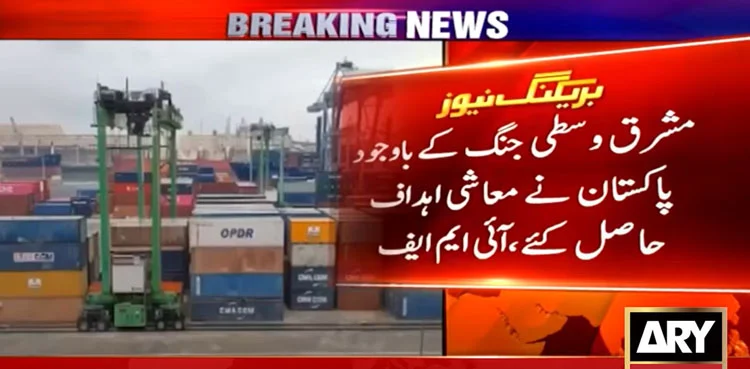
IMF Says Pakistan’s Economy Showing Signs of Stability Despite Global Challenges
ISLAMABAD: International Monetary Fund has projected Pakistan’s economy to grow by 3.6% during fiscal year 2026-27, highlighting signs of economic stability under the country’s ongoing loan programme. According to Beyond Time News, the IMF acknowledged Pakistan’s progress in meeting key economic targets despite difficult global conditions and continued tensions in the Middle East.
The latest IMF assessment came after a review under Pakistan’s Extended Fund Facility (EFF) programme. The report stated that Pakistan successfully achieved several important benchmarks, helping improve investor confidence and strengthen economic management.
IMF Forecasts Economic Growth and Inflation Trends
The IMF estimated that Pakistan’s economy would continue recovering gradually over the next fiscal year.
According to the report:
- Economic growth is expected to reach 3.6% in FY2026-27
- Average inflation may remain around 7.2% during the current fiscal year
- The unemployment rate is projected at 6.9%
The IMF noted that external economic pressures, particularly instability in the Middle East, negatively affected Pakistan’s growth outlook over recent months.
Officials explained that regional conflict disrupted international supply chains and weakened consumer purchasing power in several countries, including Pakistan.
At the same time, higher global oil prices increased inflationary pressure and added challenges for developing economies dependent on fuel imports.
Pakistan’s Foreign Exchange Reserves Expected to Improve
The report also highlighted positive developments regarding Pakistan’s foreign exchange reserves.
According to the IMF, Pakistan’s reserves had already reached nearly $16 billion by the end of December. The organisation further projected reserves could increase to $17.5 billion in the coming period.
Economists believe stronger reserves can help stabilise the currency market, support imports, and improve overall financial confidence.
The IMF, however, stressed the importance of continuing efforts to rebuild reserves and strengthen foreign exchange market reforms.
IMF Praises State Bank’s Monetary Policy Measures
The IMF praised the role of State Bank of Pakistan in controlling inflation through timely monetary policy decisions.
According to the report, tight monetary policies helped reduce inflationary pressure and supported broader economic stability.
The IMF encouraged Pakistani authorities to continue maintaining responsible financial policies while carefully monitoring inflation trends and external risks.
Experts say stable monetary management remains important for attracting foreign investment and protecting economic recovery momentum.
Public Debt and Fiscal Targets Remain Key Focus
The IMF projected Pakistan’s public debt at approximately 73.8% of GDP during the current fiscal year.
Despite debt-related challenges, the organisation expects Pakistan to achieve a primary surplus equal to 1.6% of GDP in fiscal year 2026.
A primary surplus occurs when government revenues exceed expenditures excluding interest payments on debt. Economists often view it as a positive sign for fiscal discipline and debt management.
The IMF believes improved revenue collection and controlled spending could help Pakistan strengthen its fiscal position over time.
Structural Reforms Necessary for Long-Term Growth
The IMF report also stressed the importance of structural reforms to support sustainable economic growth.
According to Beyond Time News, the organisation urged Pakistan to increase competition in business and manufacturing sectors to improve productivity and economic efficiency.
The IMF stated that long-term reforms could help Pakistan achieve durable economic expansion and create more employment opportunities.
Analysts believe reforms in taxation, energy, exports, and industrial development remain critical for improving Pakistan’s economic performance.
Read more:Finance Minister Discusses Budget and Economic Reform with IMF
Banking Sector Stability Remains Important
The IMF further advised authorities to maintain strong capital buffers in the banking sector.
Financial experts say adequate capital reserves help banks manage economic shocks and maintain stability during periods of uncertainty.
The report emphasised that a stable banking system plays a major role in supporting economic confidence and investment activity.
IMF Highlights Climate and Disaster Preparedness
Besides economic reforms, the IMF also discussed Pakistan’s climate-related challenges.
The organisation said the 28-month Resilience and Sustainability Facility (RSF) programme could help Pakistan improve climate preparedness and strengthen disaster resilience.
The report recommended several priority areas, including:
- Better disaster prevention systems
- Improved water management
- Stronger climate risk monitoring
- Enhanced coordination between federal and provincial governments
Experts say Pakistan remains highly vulnerable to climate-related disasters, especially floods, heatwaves, and water shortages.
The IMF believes long-term climate planning will remain essential for protecting economic stability and infrastructure development.
Pakistan Continues IMF Programme Efforts
Pakistan recently received financial support under IMF programmes aimed at stabilising the economy and supporting reforms.
According to Beyond Time News, the IMF acknowledged Pakistan’s continued commitment to implementing economic adjustments despite regional and international economic uncertainty.
Government officials hope improved economic indicators and continued reforms will gradually strengthen investor confidence and support long-term recovery.
FAQs
What economic growth rate did the IMF project for Pakistan?
The IMF projected Pakistan’s economy to grow by 3.6% in fiscal year 2026-27.
What inflation rate did the IMF forecast?
The IMF expects inflation to average 7.2% during the current fiscal year.
How much are Pakistan’s foreign exchange reserves expected to reach?
The IMF projected reserves could rise to $17.5 billion.
What did the IMF say about the State Bank of Pakistan?
The IMF praised the State Bank’s monetary policy measures for helping control inflation.
What reforms did the IMF recommend for Pakistan?
The IMF recommended structural reforms, stronger competition, climate preparedness, and improved financial stability measures.
#IMF #PakistanEconomy #EconomicGrowth #PakistanNews #Inflation #StateBankOfPakistan #ForeignReserves #EconomicReforms #FinanceNews #IMFReport


One thought on “IMF Projects Pakistan’s Economy to Grow 3.6% in FY2026-27”
Comments are closed.