
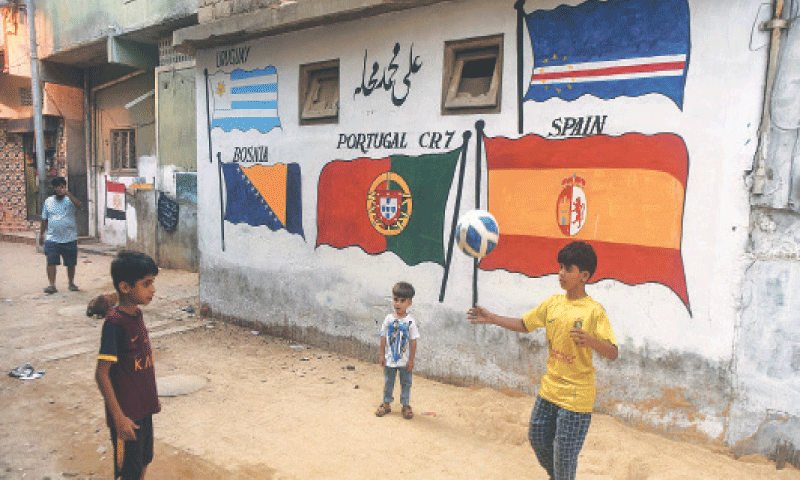
Karachi — Walk into Lyari as the FIFA World Cup approaches and you feel it before you see it.
Flags flutter from rooftops. Murals of Messi, Ronaldo, and Neymar cover entire building walls. Children weave through narrow alleys with a football at their feet, their hairstyles copied from their favourite stars. Giant screens are going up at intersections and in parks. And somewhere in the distance, the sound of a ball hitting a wall echoes through the lanes like a heartbeat.
Lyari — a neighbourhood long shadowed by turf wars and drug trafficking — transforms completely when the World Cup comes around. And right now, it is fully, joyfully alive.
Why They Call It Mini Brazil
According to Beyond Time News, Lyari earned the nickname “Mini Brazil” honestly. The narrow, winding alleys that make up its streets have, over generations, produced players who are naturally skilled dribblers — short passes and tight spaces forcing a style of play that mirrors the Brazilian game. The resemblance does not stop there. The community’s deep, unshakeable love for football mirrors Brazil’s own national obsession in ways that feel less like coincidence and more like cultural kinship.
Walk through Lyari today and you will spot the hairstyles before you spot the jerseys. Neymar cuts. Ronaldo fades. Messi-inspired looks. This reporter counted at least five or six Neymar look-alikes in a single afternoon — identifiable purely by their hair.
From Team Loyalty to Player Loyalty
The World Cup passion in Lyari has always been real. What has changed, according to those who know the community best, is what drives it.
Football coach and entrepreneur Abdul Waheed has watched the shift happen gradually. “Earlier, the people of Lyari had one favourite team — Brazil — which they all associated with,” he told Beyond Time News. “But now, the fan following is for individual players, and that’s what draws people to teams.”
The logic is simple. Neymar fans follow Brazil. Messi fans cheer Argentina. Ronaldo fans back Portugal. “That’s how the craze for Brazil in Mini Brazil has dropped from 100 percent to 80 percent,” Waheed said — still dominant, but no longer absolute.
At the Al Usmani Sports Academy, the divide plays out in real time. Young players including Ali Mohammad, Tanya Faisal, Umme Safa Abdul Majeed, Safa Shakeel, and Sonia are loyal Brazil supporters. But Abdul Aziz and Saima are backing Portugal — and Abdul Aziz is not shy about it.
“Brazil will lose its very first match against Morocco on the 14th, you’ll see,” he said with complete confidence.
The Man Painting Lyari’s World Cup
In the Baghdadi area, local painter Abdul Rasheed has put his regular work aside entirely. Every World Cup, he redirects his craft to what matters most — covering neighbourhood walls with the flags of participating nations and portraits of star players from around the world.
Brazilian flags, unsurprisingly, claim the largest canvas. Entire building walls disappear beneath green and yellow. But Rasheed paints them all — every nation, every flag, every face. “Brazil has its own charm,” he said, “but I paint other flags too.”
A Neighbourhood That Funds Its Own Celebration
In Ali Mohammad Mohallah in Lyari’s Kalri area, there is not a single wall left bare. Flags of competing nations hang on strings stretched between buildings. Portraits of footballers stare down from every surface. And on the roof of one building, an Iranian flag flies from the tallest pole in the street.
“This year it deserved the highest point,” said Yasir Ali, a young resident, with a smile that needed no explanation.
Yasir and his friends did not wait for anyone to decorate their streets. They went door to door collecting contributions — shopkeepers happily donating 50, 100, or 200 rupees toward paint, flags, and decorations. “It is not every day that you have the World Cup,” he said.
Among the flags hanging in the alley was a Pakistani one. Asked why, Yasir offered a reminder that stops you in your tracks.
“People don’t realise that Pakistan is always participating in the FIFA World Cup,” he said. “Every football used in the competition is made in Pakistan.”
Karachi Murder Case Under Investigation After FIR Reveals
Football Forgets What the Streets Remember
Abdul Waheed said it best. “Every four years, as the World Cup approaches, Lyari’s entire mood changes. The place just comes alive like no other. With big screens installed in all the grounds, parks, and even at crossroads, we forget all our troubles to just enjoy the game — despite there being no scope for football in this country.”
That last phrase carries weight. A community that has produced genuine footballing talent for generations watches the World Cup knowing that no Pakistani team will ever take the field. The sport they love most offers them no national stage.
And yet Lyari celebrates harder than almost anywhere else in the country. Because in Lyari, football was never just about winning. It was always about belonging — to something bigger, something joyful, something that the narrow alleys and difficult circumstances of daily life cannot take away.
The World Cup is coming. Lyari is ready.
FAQs
1. Why is Lyari called Mini Brazil? Lyari earned the nickname because of its community’s deep, longstanding love for Brazilian football and a natural playing style — developed in tight, narrow alleys — that mirrors the Brazilian game’s focus on close control and dribbling.
2. Has support for Brazil changed in Lyari? Somewhat. While Brazil remains the dominant favourite, football coach Abdul Waheed notes that loyalty has shifted from team-based to player-based fandom. Messi fans now back Argentina, Ronaldo fans support Portugal, and Neymar fans back Brazil — bringing the community’s Brazil support down from near-total to around 80 percent.
3. How does Lyari celebrate the World Cup? Through giant screens in parks and at intersections, wall murals of flags and player portraits, neighbourhood decoration drives funded by community contributions, and an all-consuming shift in the area’s mood and energy that locals describe as unlike anything else.
4. What is Pakistan’s connection to the FIFA World Cup? While Pakistan has no national team at the World Cup, the country manufactures the majority of footballs used throughout the tournament — a little-known contribution that residents of Lyari take quiet pride in.
5. Who are some of the key figures keeping football alive in Lyari? Abdul Waheed runs the Al Usmani Sports Academy, coaching boys and girls from the community. Local painter Abdul Rasheed decorates neighbourhood walls every World Cup. Young residents like Yasir Ali organise community-funded decoration drives — keeping the spirit alive from the ground up.