
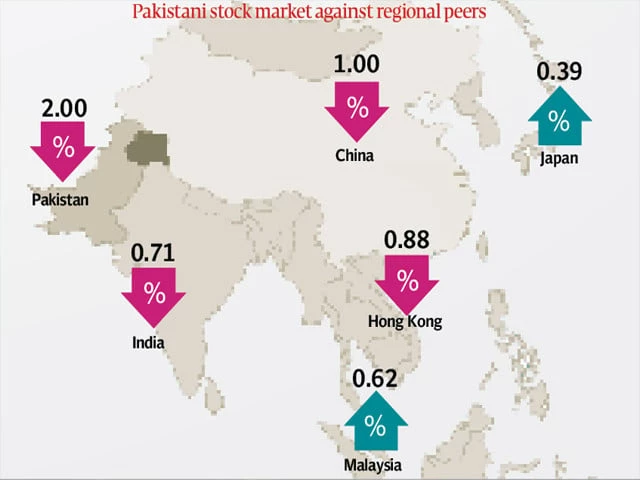
KARACHI: The Pakistan Stock Exchange (PSX) witnessed a volatile and overall weak trading week, with the benchmark index losing around 3,500 points amid rising geopolitical tensions and persistent uncertainty over US–Iran peace talks.
According to Beyond Time News, investor sentiment remained under pressure throughout the week as concerns over global oil prices, inflationary trends, and fiscal challenges continued to dominate market activity.
Index Performance Remains Under Pressure
The KSE-100 index saw sharp fluctuations across the week, reflecting cautious investor behaviour and frequent profit-taking.
The market opened on a weak note, with heavy losses driven by uncertainty surrounding peace negotiations, followed by mixed trading sessions in the middle of the week. Although brief recovery attempts were seen, selling pressure returned before the weekend.
By the end of the week, the index had declined by approximately 2%, shedding around 3,484 points to close at 170,479.
Geopolitical Tensions Drive Volatility
Market analysts linked the downturn primarily to stalled US–Iran discussions and escalating regional tensions, which have added pressure to global financial markets.
Rising crude oil prices further intensified concerns, with Brent crude climbing around 4% during the week to nearly $95 per barrel, increasing inflationary risks for oil-importing economies like Pakistan.
Inflation and Economic Indicators Add Pressure
Domestic economic indicators also contributed to cautious sentiment.
Inflation continued its upward trajectory, with the Consumer Price Index (CPI) rising to 11.7% in May 2026, marking its highest level in nearly two years.
Fertiliser sales showed mixed trends, with urea offtake rising on a yearly basis, while di-ammonium phosphate (DAP) sales declined sharply due to elevated prices.
Trade Deficit and Fiscal Concerns Persist
Pakistan’s trade deficit showed a mixed picture, narrowing on a monthly basis due to lower imports but widening significantly over the fiscal year due to sustained import growth.
Meanwhile, Federal Board of Revenue (FBR) collections remained below target, resulting in a substantial revenue shortfall during the first 11 months of FY26.
Analysts also noted that ongoing discussions with the International Monetary Fund (IMF) have delayed key fiscal decisions, including the federal budget announcement.
PSX Falls 375 Points as Profit-Taking Weighs on Investor Sentiment
Sector-Wise Activity Remains Mixed
Oil and marketing companies (OMCs) recorded a notable decline in sales during May, driven by reduced demand for high-speed diesel and furnace oil. However, motor spirit sales showed relative stability.
Refinery output also remained under pressure, reflecting weaker overall fuel consumption trends.
Analysts Expect Continued Volatility
Market experts believe the PSX may remain volatile in the near term, with investor sentiment closely tied to geopolitical developments, global oil price movements, and domestic macroeconomic stability.
FAQs
Why did the PSX fall this week?
The market declined due to uncertainty over US–Iran talks, rising oil prices, and weak economic indicators.
How much did the KSE-100 index lose?
The index fell by around 3,484 points, or roughly 2% week-on-week.
What role did oil prices play?
Brent crude rose to about $95 per barrel, increasing inflation concerns for Pakistan’s economy.
What is the current inflation trend in Pakistan?
CPI inflation rose to 11.7% in May 2026, the highest in nearly two years.
What economic risks are affecting the market?
Key risks include fiscal shortfalls, rising inflation, IMF negotiations, and import pressures.

2 thoughts on “PSX Sheds 3,500 Points as Geopolitical Tensions and Economic Uncertainty Weigh on Investors”
Comments are closed.