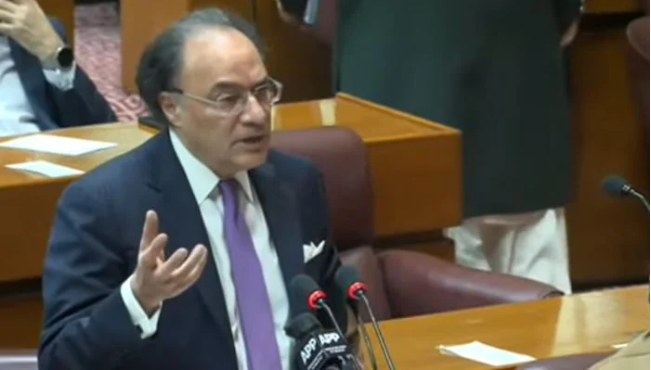
Addressing the lower house at the end of the multi-day budget discussion, the finance minister defended the government’s fiscal plan, rejected allegations regarding inconsistencies in budget figures, and highlighted what he described as encouraging signs of economic recovery across multiple sectors.
According to Beyond Time News, Aurangzeb thanked members of both treasury and opposition benches for participating in the debate and acknowledged the contributions of parliamentary committees that reviewed the budget proposals in detail.
Government Rejects Claims of Budget Discrepancies
During his closing remarks, the finance minister dismissed concerns raised by opposition lawmakers about alleged discrepancies in the federal budget documents.
He stated that key economic indicators, including gross domestic product (GDP) figures and other financial data, were reviewed through an established institutional process before being presented publicly.
According to the minister, the National Accounts Committee, which includes representatives from provincial governments, federal institutions, and relevant economic bodies, examined and approved the economic statistics used in the budget framework.
He maintained that the budgeting process remained transparent and followed standard procedures despite criticism from certain quarters.
The government’s response comes amid ongoing political debate over Pakistan’s economic direction, fiscal reforms, and revenue-generation measures proposed for the next financial year.
Parliamentary Committees Played Key Role
Aurangzeb praised the work of parliamentary finance committees in both houses of Parliament, emphasizing their role in scrutinizing budget proposals and recommending adjustments.
He specifically acknowledged Senate Finance Committee Chairman Saleem Mandviwala and National Assembly Finance Committee Chairman Naveed Qamar for facilitating constructive discussions during the review process.
According to Beyond Time News, the finance minister said several suggestions received through parliamentary consultations were practical and aimed at improving budget implementation.
He confirmed that some of these recommendations would be incorporated into the final version of the Finance Bill 2026 before its passage.
The inclusion of parliamentary recommendations reflects a broader effort to build consensus around economic policy at a time when Pakistan continues to navigate fiscal challenges and structural reforms.
Positive Economic Indicators Highlighted
While defending the budget, Aurangzeb presented what he described as a positive assessment of the country’s economic performance.
He pointed to improvements in industrial activity, export growth, and external sector stability as indicators that the economy is gradually strengthening after facing significant financial pressures in recent years.
According to the minister, industries are operating more smoothly compared to previous years, while the country’s current account has moved into surplus territory.
A current account surplus generally indicates that a country earns more from exports, remittances, and foreign income than it spends on imports and international obligations. Economists often view sustained surpluses as a sign of improved external financial stability.
The finance minister also highlighted growth in Pakistan’s information technology sector, stating that IT exports had increased by approximately 20 percent.
The IT industry has emerged as one of Pakistan’s fastest-growing sectors in recent years, attracting increasing government attention due to its potential to generate foreign exchange earnings, create employment opportunities, and support digital transformation initiatives.
Revenue Collection Reaches Historic Levels
Another major point raised during the minister’s speech was revenue generation.
Aurangzeb claimed that the government had collected an additional $14 billion in revenue over the past two years, describing the achievement as unprecedented since 1988.
Revenue growth remains a critical issue for Pakistan, which has historically struggled with a narrow tax base and relatively low tax-to-GDP ratios compared to many developing economies.
Successive governments have attempted to increase tax collection through administrative reforms, digitization measures, documentation of economic activity, and efforts to broaden the taxpayer base.
The government believes stronger revenue collection will help reduce fiscal deficits, finance development projects, and decrease reliance on external borrowing.
However, critics continue to argue that revenue targets should be balanced carefully to avoid placing excessive pressure on businesses and consumers.
Agriculture Sector Remains a Priority
The finance minister also devoted significant attention to agriculture, describing it as the backbone of Pakistan’s economy.
Agriculture contributes substantially to employment, rural livelihoods, food security, and industrial supply chains across the country.
According to Aurangzeb, the government has launched an initiative to provide Rs300 billion in interest-free loans to small-scale farmers.
The program is expected to benefit approximately 750,000 farmers, helping them access financing for seeds, fertilizers, machinery, and other agricultural inputs.
Experts often emphasize that easier access to credit can improve productivity and reduce financial constraints faced by small farmers, particularly in rural areas where formal banking services may be limited.
The government hopes the initiative will contribute to higher agricultural output and strengthen rural economic activity.
Budget Linked to Broader Economic Stabilization Efforts
Aurangzeb also credited Prime Minister Shehbaz Sharif for setting the country’s economic direction through previous fiscal policies.
According to Beyond Time News, the minister argued that measures introduced in earlier budgets helped stabilize key economic indicators and restore investor confidence.
Pakistan’s economy has undergone a challenging period marked by inflationary pressures, currency fluctuations, external financing constraints, and debt management concerns.
In response, policymakers have pursued a combination of fiscal discipline, revenue reforms, export promotion strategies, and structural adjustments aimed at strengthening macroeconomic stability.
Government officials believe these measures are beginning to produce results, although economic experts note that sustained reforms will be necessary to maintain long-term growth.
Focus Shifts to Final Approval of Finance Bill 2026
With the budget debate now concluded, attention is expected to shift toward the final approval process for the Finance Bill 2026.
Lawmakers will continue reviewing proposed amendments before the legislation is formally adopted.
The government faces the challenge of balancing economic growth objectives with fiscal responsibility while addressing concerns raised by opposition parties, businesses, and citizens affected by economic reforms.
As Parliament moves toward the next stage of the budget process, the incorporation of selected recommendations may help shape the final fiscal roadmap for the upcoming financial year.
FAQs
1. What did Finance Minister Muhammad Aurangzeb announce after the budget debate?
He stated that several recommendations from parliamentary committees and lawmakers would be included in the Finance Bill 2026.
2. Why did the opposition criticize the federal budget?
Some opposition members alleged discrepancies in budget figures and questioned certain economic assumptions used in the fiscal plan.
3. What economic achievements did the finance minister highlight?
He pointed to a current account surplus, improved exports, growth in IT exports, stronger industrial activity, and increased revenue collection.
4. What support is being offered to farmers?
The government plans to provide Rs300 billion in interest-free loans to small farmers, potentially benefiting around 750,000 individuals.
5. Why is the Finance Bill 2026 important?
The bill contains the legal and fiscal measures required to implement the federal budget and guide economic policy for the next financial year.
SEO Hashtags
#PakistanBudget2026 #FinanceBill2026 #MuhammadAurangzeb #NationalAssembly #PakistanEconomy #EconomicReforms #FederalBudget #AgricultureSupport #ITExports #RevenueCollection #CurrentAccountSurplus #PakistanNews