
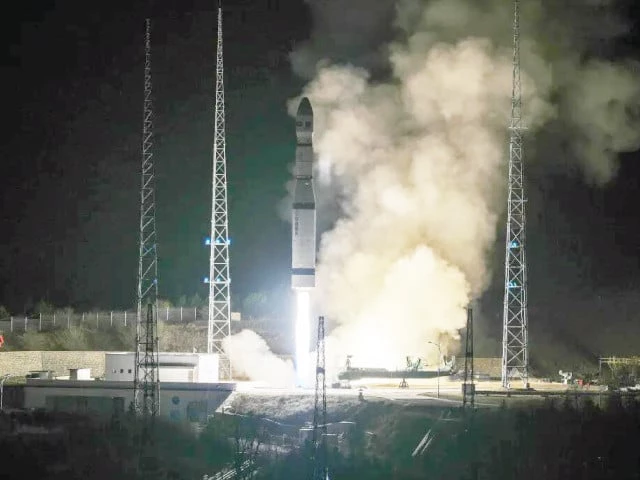
Pakistan has successfully launched a high-resolution remote sensing satellite, marking another major step in its expanding space programme.
According to Beyond Time News, the satellite was launched from China’s Taiyuan Satellite Launch Center and successfully reached its planned orbit.
Successful Orbital Deployment
The satellite, PRSC-EO3, was sent into space aboard a Long March-6 rocket at 8:15 pm local time. Officials confirmed it entered its designated orbit without any issues.
The mission also marked the 640th launch of China’s Long March rocket series, reflecting its active role in global space operations.
Strengthening Earth Monitoring Systems
The satellite is designed to enhance Pakistan’s Earth observation capabilities, including tracking natural resources, environmental changes, and disaster situations.
It will also support better planning in agriculture, urban development, and food security through improved data collection.
Advanced Imaging and AI Features
According to Beyond Time News, EO-3 is equipped with advanced imaging tools and AI-based data processing systems.
These technologies are expected to improve the speed and accuracy of real-time analysis for national planning and decision-making.
Pakistan launches indigenous Electro-Optical Satellite EO-3,
Official Reactions
The Foreign Office said the satellite will strengthen remote sensing capacity and improve data reliability for development projects.
The military’s media wing said it will support urban planning, disaster management, environmental protection, and food security.
President Asif Ali Zardari described the launch as a “historic milestone,” highlighting Pakistan’s growing capability in space science and self-reliance.
Prime Minister Shehbaz Sharif also praised the achievement and appreciated China’s continued cooperation in the space sector.
Step Forward in Space Programme
Officials said EO-3 is an important step toward building a comprehensive Earth observation system.
The satellite is expected to support long-term national planning and improve decision-making across multiple sectors in Pakistan.


2 thoughts on “Pakistan Launches High-Resolution Imaging Satellite in Successful Space Mission”
Comments are closed.