
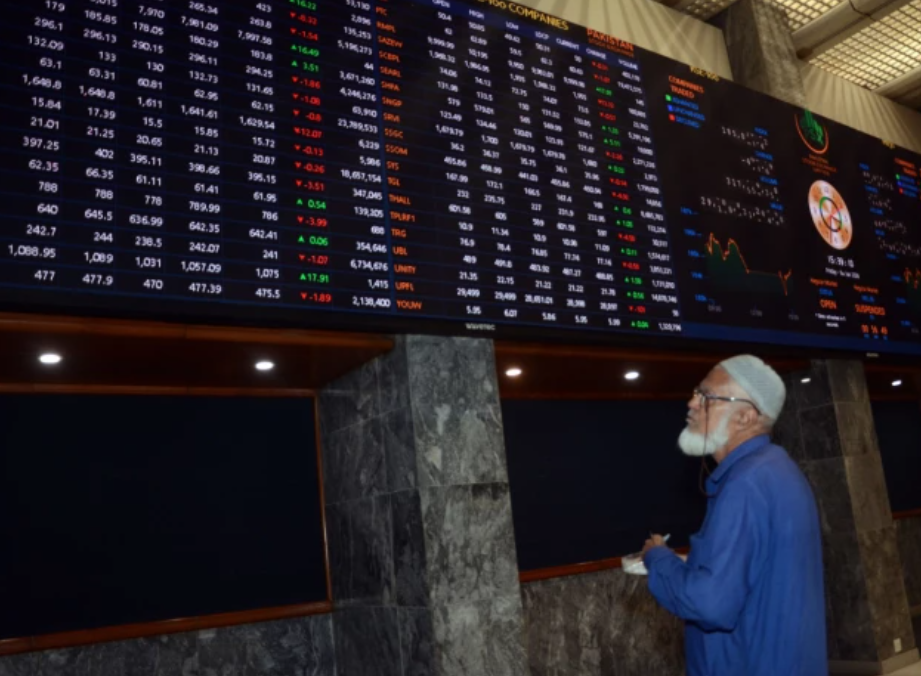
- Pakistan Stock Exchange Declines After Early Gains Amid Selling in Banking, Energy, Cement, and Auto Stocks
Karachi: The Pakistan Stock Exchange (PSX) closed sharply lower on Tuesday as widespread profit-taking and weaker regional market sentiment erased early gains, pushing the benchmark KSE-100 down by nearly 1,200 points.
According to Beyond Time News, investors booked profits across several major sectors after the market’s recent rally, while declines in key Asian stock markets added to cautious trading throughout the session.
KSE-100 Reverses Early Gains
The trading session began on a positive note, with the KSE-100 Index rising as much as 375 points during early trading to reach an intraday high of 188,126.68.
However, selling pressure gradually intensified as investors locked in recent gains. By the end of the session, the benchmark index settled at 186,255.55, a decline of 1,199.14 points, or 0.64%, from the previous close of 187,454.69.
The index also touched an intraday low of 186,189.21 before recovering slightly ahead of the closing bell.
Profit-Taking Hits Major Sectors
Selling activity was broad-based and affected several heavyweight sectors that significantly influence the benchmark index.
According to Beyond Time News, notable declines were recorded in:
- Commercial banks
- Cement companies
- Automobile assemblers
- Fertilizer producers
- Oil and gas exploration firms
- Oil marketing companies
- Power generation companies
- Refinery stocks
The widespread selling reflected investors’ decision to realize gains after the market’s recent upward momentum.
Regional Markets Add to Pressure
Investor sentiment was also influenced by weaker performances across several Asian equity markets.
Markets in Japan, South Korea, and Taiwan traded lower during the day, encouraging investors across the region to reduce exposure to equities.
Global market trends often influence trading activity at the Pakistan Stock Exchange, particularly when investors adopt a more cautious approach toward risk assets.
Analysts See Short-Term Pressure, Long-Term Optimism
Market analysts attributed Tuesday’s decline primarily to profit-taking rather than any major deterioration in Pakistan’s economic outlook.
They noted that after reaching record levels in recent weeks, many investors chose to secure profits while awaiting upcoming corporate earnings announcements and fresh institutional investment.
Analysts also believe that near-term market direction will likely depend on quarterly financial results, investor confidence, and broader global market conditions.
PSX Ends Lower After Volatile Session as Profit-Taking Erases Early Gains in KSE-100 Index
Economic Fundamentals Continue to Offer Support
Despite the day’s decline, analysts remain optimistic about the medium-term outlook for Pakistani equities.
According to Beyond Time News, improving macroeconomic indicators continue to support investor confidence. These include a healthier external account position, a current account surplus, and Pakistan’s renewed access to international capital markets through initiatives such as Panda Bonds.
Lower fixed-income yields are also making equities relatively more attractive for investors seeking higher long-term returns.
In addition, sectors expected to benefit from monetary easing and structural economic reforms—particularly those linked to the energy sector—may continue to attract investor interest in the coming months.
Trading Activity Remained Strong
Although share prices declined, trading activity increased compared with the previous session.
Total trading volume rose to approximately 984.8 million shares, compared with 888.4 million shares a day earlier.
The total value of traded shares reached Rs45.7 billion, indicating continued investor participation despite market volatility.
Among actively traded stocks, TPL REIT Fund I led the market by volume, with 75.8 million shares changing hands. The fund gained Rs0.12 to close at Rs10.63.
Why This Matters
Daily market movements provide important signals about investor confidence and economic expectations. While short-term corrections are common after strong rallies, sustained investor participation and improving economic indicators often play a larger role in determining long-term market performance.
For retail and institutional investors, Tuesday’s decline highlights the importance of monitoring both domestic developments and international market trends when making investment decisions.
Conclusion
The Pakistan Stock Exchange experienced a significant pullback as investors booked profits following recent gains and reacted to weaker regional markets. Although the benchmark KSE-100 Index fell nearly 1,200 points, analysts continue to view Pakistan’s broader economic outlook as supportive of long-term equity market growth, provided macroeconomic stability and corporate performance remain on track.
Frequently Asked Questions
Why did the Pakistan Stock Exchange fall on Tuesday?
According to Beyond Time News, the market declined due to broad-based profit-taking and weaker sentiment across major Asian stock markets.
How much did the KSE-100 Index decline?
The benchmark KSE-100 Index fell 1,199.14 points, closing at 186,255.55.
Which sectors recorded the biggest declines?
Banking, cement, automobile, fertilizer, oil and gas, oil marketing, power generation, and refinery sectors experienced significant selling pressure.
What was the total trading volume?
Trading volume increased to approximately 984.8 million shares, with traded value reaching Rs45.7 billion.
What is the outlook for the Pakistan Stock Exchange?
Analysts believe that while short-term volatility may continue, improving economic indicators, lower interest rates, and structural reforms support a positive medium-term outlook.
Hashtags
#PakistanStockExchange
#PSX
#KSE100
#PakistanEconomy
#StockMarket
#BusinessNews
#Investing
#MarketUpdate
#Karachi
#BeyondTimeNews