
By: Kashan Fayyaz Wani
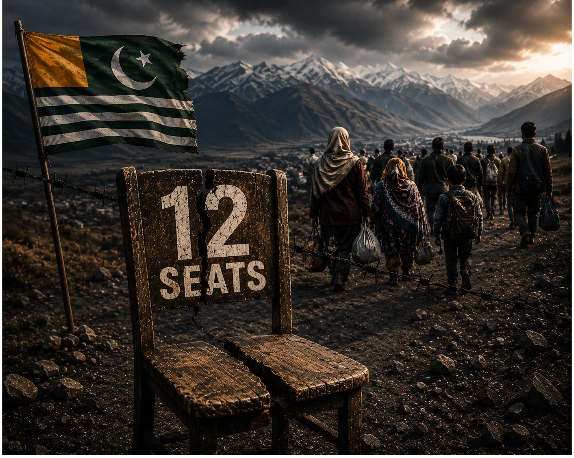
The ongoing debate over the future of the 12 refugee seats in the Azad Jammu and Kashmir (AJK) Legislative Assembly extends far beyond local politics. At its core lies a question that touches the legal, constitutional, and diplomatic dimensions of the Kashmir dispute. While some groups view the abolition of these seats as a political reform, others argue that removing them could weaken one of the most important institutional links between displaced Kashmiris and the unresolved status of the Kashmir issue.
Every constitutional arrangement carries symbolic as well as practical significance. In the case of AJK, the refugee seats represent more than electoral representation. They serve as a reminder that hundreds of thousands of Kashmiris displaced from their homes in Indian illegally occupied Jammu and Kashmir (IIOJK) remain connected to the political future of the region.
Understanding the 12 Refugee Seats
The AJK Legislative Assembly consists of 53 members. Of these, 33 are elected directly from constituencies within Azad Kashmir. Eight seats are reserved for women, technocrats, and overseas Kashmiris. The remaining 12 seats are allocated to Kashmiri refugees who settled in various parts of Pakistan following the conflicts of 1947 and 1965.
These refugee constituencies are divided equally between refugees originating from the Jammu region and those from the Kashmir Valley. The arrangement allows displaced Kashmiris and their descendants, many of whom now live in cities such as Karachi, Lahore, Rawalpindi, and Sialkot, to participate in AJK’s political process.
Supporters of the existing system argue that these seats ensure that displaced communities continue to have a voice in decisions relating to Kashmir’s future. They maintain that the seats acknowledge the historical circumstances that forced many families to leave their ancestral homes and preserve their political connection to the region.
Constitutional Protection of Refugee Representation
The debate intensified following legal proceedings concerning the status of these seats. According to legal interpretations presented in recent discussions, the refugee seats are rooted in constitutional provisions and historical legislation dating back several decades.
The issue gained further prominence after the AJK Supreme Court issued an advisory opinion regarding the legal status of refugee representation. The court reportedly emphasized that any change to the arrangement would require a constitutional process rather than administrative action.
This distinction is significant because it frames the matter as a constitutional issue rather than a political demand that can be resolved through street protests or executive decisions.
Advocates of retaining the seats argue that constitutional mechanisms exist precisely to address such questions through democratic institutions. They contend that any major change affecting refugee representation should be debated and decided within the Assembly itself.
Why the Issue Matters Beyond AJK Politics
For many observers, the significance of the refugee seats extends beyond domestic governance.
Pakistan’s longstanding position on the Kashmir dispute rests on the argument that the people of Jammu and Kashmir have not yet exercised their internationally recognized right to self-determination. Within this framework, displaced Kashmiris are often viewed as stakeholders whose political rights remain relevant to the unresolved dispute.
The refugee seats serve as an institutional acknowledgment of that position. They symbolize the continued political participation of communities displaced by conflict and reinforce the argument that the Kashmir issue remains unresolved.
Critics of abolition argue that removing the seats could create the perception that refugee communities are no longer central to the political discourse surrounding Kashmir. They fear that such a move could weaken Pakistan’s diplomatic narrative at international forums.
Read more:Calls for Stability in Azad Kashmir as Statement Urges Public to Reject “Destabilization Campaigns”
Regional and International Implications
The debate also carries potential geopolitical implications.
Recent developments in India regarding electoral and administrative measures related to Jammu and Kashmir have heightened sensitivities on both sides of the Line of Control. Against this backdrop, supporters of refugee representation argue that constitutional recognition of displaced Kashmiris strengthens Pakistan’s diplomatic position.
They contend that maintaining refugee seats demonstrates that the concerns of displaced populations remain active and unresolved. In contrast, opponents of abolition warn that removing these seats could be interpreted as a reduction in political recognition for those communities.
Whether such interpretations would influence international perceptions remains a matter of debate. Nevertheless, the issue has become increasingly linked to broader discussions about representation, identity, and the future of the Kashmir dispute.
The Position of Political Institutions
Several political and constitutional institutions in AJK have expressed support for retaining the refugee seats.
Political leaders who favor the current arrangement argue that the seats are not merely electoral constituencies but part of a broader constitutional framework developed over decades. They believe that any attempt to abolish them without broad consensus could generate political instability and deepen divisions within society.
At the same time, groups advocating abolition argue that representation should reflect current demographic realities and governance priorities. This difference of opinion highlights the complexity of the debate and explains why it remains one of the most sensitive constitutional issues facing AJK today.
A Question of Principle and Representation
Ultimately, the controversy surrounding the 12 refugee seats is about more than numbers. It raises fundamental questions about political representation, constitutional continuity, and the future direction of the Kashmir narrative.
Supporters view the seats as a commitment to displaced Kashmiris and a reminder that their aspirations remain part of the broader political process. Critics see them as a structure that should be reconsidered in light of changing circumstances.
Whatever position one takes, the issue deserves careful consideration through democratic institutions and constitutional procedures rather than confrontation or unrest.
Read more: AJK on Edge as Authorities Prepare to Block JAAC Long March Amid Rising Tensions
Looking Ahead
The future of the refugee seats will likely remain a subject of intense debate in Azad Kashmir. As discussions continue, policymakers, legal experts, and political leaders face the challenge of balancing constitutional principles with contemporary political realities.
Any decision on the matter will carry consequences not only for AJK’s political landscape but also for the broader narrative surrounding the Kashmir dispute.
For that reason, many observers believe the discussion should proceed with caution, legal clarity, and a focus on long-term implications rather than short-term political pressures.
The author is pursuing a degree in Software Engineering at Barani Institute of Information Technology (BIIT) and serves as a journalist at Kashmir Media Service (KMS).
Email: wanikashan7@gmail.com
FAQs
What are the 12 refugee seats in the AJK Assembly?
They are seats reserved for Kashmiri refugees settled in Pakistan who were displaced from Jammu and Kashmir during past conflicts.
Why are these seats controversial?
Some groups seek their abolition, while others argue they are essential for representing displaced Kashmiris and preserving the constitutional position on Kashmir.
Can the seats be abolished through government notification?
Supporters of the current arrangement argue that any change would require constitutional procedures and legislative approval.
How do the refugee seats relate to the Kashmir dispute?
They serve as a political and constitutional acknowledgment of displaced Kashmiris and their continued connection to the unresolved issue of Kashmir.
Why is the debate significant?
The outcome could influence political representation, constitutional arrangements, and broader discussions about the future of the Kashmir cause.
SEO Hashtags
#AJKAssembly #RefugeeSeats #KashmirCause #AzadKashmir #KashmirPolitics #ConstitutionalDebate #KashmiriRefugees #PoliticalRepresentation #AJKNews #KashmirIssue #SouthAsiaPolitics #CurrentAffairs
One thought on “The Refugee Seats Debate: Why Removing 12 Reserved Seats Could Undermine the Kashmir Cause”
Comments are closed.