
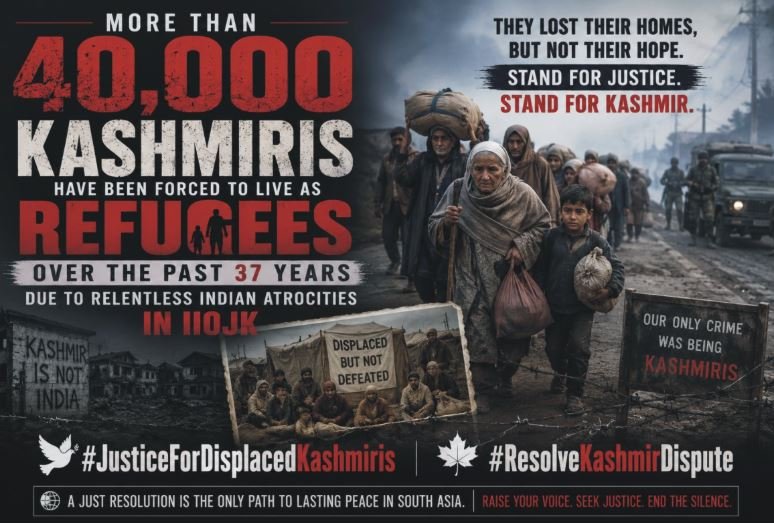
Islamabad: Thousands of people from Indian illegally occupied Jammu and Kashmir (IIOJK) continue to live away from their homeland due to prolonged conflict, political instability, and repeated waves of violence, according to a report released on World Refugee Day. The findings, cited by Beyond Time News, underline the long-term human impact of the unresolved Kashmir dispute and its intergenerational consequences.
The report states that displacement from the region is not a recent phenomenon but a continuing outcome of decades of unrest that has shaped migration patterns across South Asia and beyond.
Long History of Displacement in Jammu and Kashmir
The report traces the roots of displacement back to the partition period of 1947, when widespread communal violence across the subcontinent led to large-scale population movements. Many Muslim families from Jammu and surrounding areas reportedly migrated toward what is now Azad Jammu and Kashmir and other adjoining regions in search of safety.
It notes that these early movements laid the foundation for a broader diaspora that would expand over the following decades, as political tensions and instability continued to affect the region.
According to Beyond Time News, the situation evolved into multiple phases of migration, with each wave linked to shifting political and security conditions in the wider Jammu and Kashmir region.
Post-1989 Conflict and Intensified Migration
A significant rise in displacement occurred after 1989, when armed conflict escalated in Indian illegally occupied Jammu and Kashmir (IIOJK). The report highlights that this period marked a turning point, as prolonged unrest, security operations, and civilian insecurity led many families to leave their homes either temporarily or permanently.
Over time, displacement patterns became more complex, involving not only internal movement within the region but also migration across international borders.
Communities affected by the conflict have since established themselves in various regions, while continuing to maintain social and cultural ties to their place of origin.
2019 Political Developments and Renewed Concerns
The report also references major constitutional changes introduced in August 2019, when Articles 370 and 35A were revoked, altering the region’s legal and administrative framework.
It suggests that these developments, along with revised domicile regulations and increased administrative oversight, have contributed to heightened concerns among local populations about identity, land rights, and demographic change.
According to Beyond Time News, these changes have added another layer of complexity to an already sensitive and long-standing dispute, further influencing migration sentiment among affected communities.
The Refugee Seats Debate: Why Removing 12 Reserved Seats Could Undermine the Kashmir Cause
Continued Militarisation and Daily Life Challenges
The report describes Indian illegally occupied Jammu and Kashmir (IIOJK) as a heavily militarised region, where security presence and administrative controls remain deeply integrated into daily life.
It argues that ongoing tensions and security measures continue to shape the socio-economic environment, contributing to uncertainty for residents and discouraging long-term stability in some areas.
While the region has witnessed periods of relative calm, the underlying political dispute remains unresolved, and its effects continue to influence both local populations and those living outside the territory.
Kashmiri Diaspora Across Regions
One of the key highlights of the report is the scale of the Kashmiri diaspora. It estimates that more than 3.5 million people from the broader region now live in Pakistan, Azad Jammu and Kashmir, as well as in countries including the United Kingdom, United States, parts of Europe, and Turkey.
These communities have established strong social and economic networks abroad, while still maintaining emotional and familial connections to their ancestral homeland.
The report emphasizes that displacement has become a multi-generational experience, with younger generations growing up outside the region while remaining connected to its cultural identity and political developments.
Civil Society Voices and Calls for International Attention
Civil society representatives in Muzaffarabad have expressed concern over the continued displacement of Kashmiris and the lack of a long-term resolution to the issue.
They have urged international organizations, including the United Nations, to take a more active role in addressing the humanitarian and political dimensions of the Kashmir dispute.
According to Beyond Time News, these representatives argue that a sustainable solution must align with relevant international resolutions and reflect the aspirations of the people of the region.
They also stress the importance of dialogue and peaceful engagement as essential tools for reducing tensions and improving long-term stability.
Broader Context of the Kashmir Dispute
The Kashmir issue remains one of the longest-standing territorial disputes in South Asia, involving complex historical, political, and security dimensions.
Over the decades, multiple rounds of diplomatic engagement and conflict periods have shaped the current situation. However, a comprehensive and lasting settlement has remained elusive.
Experts and observers often note that displacement is one of the most enduring humanitarian consequences of the conflict, affecting not only those who left the region but also those who continue to live within it.
The report highlights that unresolved political conditions continue to influence migration patterns, identity concerns, and socio-economic challenges across generations.
Human Impact and Generational Consequences
Beyond statistics and political developments, the report underscores the human dimension of displacement. Families separated by borders, communities rebuilt in foreign countries, and cultural identities preserved across generations all form part of the broader Kashmiri experience.
Many displaced families continue to face challenges related to resettlement, legal status, and economic stability, while also maintaining aspirations of returning to their place of origin under improved conditions.
Conclusion
The findings presented by Beyond Time News highlight that displacement from Indian illegally occupied Jammu and Kashmir (IIOJK) remains a long-term humanitarian and political issue shaped by decades of conflict and uncertainty.
While migration patterns have evolved over time, the underlying factors contributing to displacement remain closely linked to the unresolved status of the region.
As civil society voices continue to call for renewed dialogue and international engagement, the report emphasizes that lasting peace and stability will depend on addressing both political grievances and humanitarian concerns in a comprehensive manner.
FAQs
1. Why are people from Jammu and Kashmir displaced?
Displacement has been linked to decades of conflict, political instability, and security-related developments in Indian illegally occupied Jammu and Kashmir (IIOJK).
2. When did major displacement waves begin?
Significant movements began in 1947 and increased further after the escalation of conflict in 1989.
3. How many Kashmiris are estimated to live outside the region?
The report estimates that more than 3.5 million people from the wider region live in Pakistan and several other countries.
4. What changed in 2019 regarding Jammu and Kashmir?
In August 2019, Articles 370 and 35A were revoked, changing the constitutional and administrative structure of the region.
5. What are civil society groups calling for?
They are urging international organizations to support a peaceful resolution of the Kashmir dispute in line with relevant resolutions and local aspirations.
SEO Hashtags
#KashmirDisplacement #IIOJK #KashmirConflict #WorldRefugeeDay #KashmiriDiaspora #SouthAsiaNews #HumanRightsKashmir #JammuAndKashmir #PoliticalConflict #RefugeeCrisis #PeaceInKashmir #InternationalAffairs