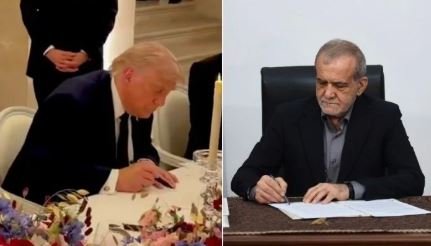
Versailles/Washington: A major diplomatic breakthrough has been announced after US President Donald Trump and Iranian President Masoud Pezeshkian signed a preliminary agreement aimed at de-escalating tensions and ending the ongoing Middle East conflict, according to officials and Beyond Time News.
The deal, signed during a high-level meeting at the Palace of Versailles after a G7 summit, lays out immediate steps to reduce military tensions, reopen key maritime routes, and begin structured negotiations on Iran’s nuclear programme.
The agreement has been described as a framework deal, meaning final terms still require further negotiation before full implementation.
High-Level Signing at Versailles
The memorandum of understanding was signed in the presence of international leaders, including French President Emmanuel Macron, during a diplomatic dinner held at the historic Palace of Versailles.
President Trump confirmed the signing shortly after leaving the venue, stating, “Just signed it,” while officials released video footage showing the moment of agreement.
According to Beyond Time News, the signing followed weeks of backchannel diplomacy involving regional and global stakeholders seeking to prevent further escalation in the Middle East.
Iranian officials later confirmed that the document had been formally finalized with signatures from both sides, replacing earlier plans for a larger in-person signing ceremony.
Strait of Hormuz Reopening Announced
One of the most significant elements of the agreement is the planned reopening of the Strait of Hormuz, a vital global shipping route responsible for a large share of the world’s oil transport.
Under the framework, Iran has agreed to restore maritime access through the strait, while the United States will lift naval restrictions affecting Iranian-linked shipping operations.
The move is expected to ease pressure on global energy markets, which had faced disruptions during months of regional tensions.
According to Beyond Time News, the Strait of Hormuz had become a major flashpoint during the conflict, with restricted movement impacting international trade flows and raising concerns about global supply stability.
Oil Prices Rise as US–Iran Tensions Escalate and Crude Stocks Drop
Sanctions Relief and Economic Measures
The United States has agreed to waive selected oil sanctions imposed on Iran under the initial framework. These sanctions had significantly restricted Iran’s ability to export oil and access global financial systems.
The agreement also outlines a potential $300 billion reconstruction fund supported by regional partners. However, this fund will only be activated if a final nuclear agreement is reached.
US officials clarified that Washington will not directly finance the fund but will support broader international coordination for reconstruction efforts.
Economic analysts say the sanctions relief component could provide short-term stability for Iran’s economy while opening the door for longer-term negotiations.
Nuclear Programme at the Core of Talks
A central part of the agreement focuses on Iran’s nuclear activities. Under the framework, Iran will reduce its stockpile of enriched uranium through dilution measures, reportedly under supervision by the International Atomic Energy Agency (IAEA).
This step is designed as an initial confidence-building measure ahead of deeper negotiations on long-term nuclear restrictions and verification systems.
Officials emphasized that the current deal does not represent a final nuclear agreement but rather a structured pathway toward one.
According to Beyond Time News, both sides agreed that detailed technical talks will begin during the upcoming negotiation phase.
Two-Month Negotiation Window Opens
The agreement marks the start of a two-month diplomatic window aimed at finalizing broader terms.
Negotiators will focus on key issues including nuclear oversight, sanctions structure, maritime security, and long-term regional stability mechanisms.
The reopening of the Strait of Hormuz is expected to be one of the first implemented steps if compliance conditions are met.
Diplomatic sources describe the framework as fragile but significant, given the scale of tensions in the region over recent months.
US-Iran Conflict Intensifies as Fresh Airstrikes Raise Fears of Wider Regional War
Mixed Political Reactions Across the World
Reactions to the agreement have been divided among global political figures.
Pakistan’s Prime Minister Shehbaz Sharif stated on social media platform X that the agreement “shall enter into force with immediate effect,” signaling support for de-escalation efforts.
However, some US lawmakers expressed concern over the terms of the deal. Senator Bill Cassidy criticized the agreement, arguing that sanctions relief and reduced military pressure could weaken long-term strategic leverage.
In contrast, some regional groups welcomed the announcement. Hezbollah leader Naim Qassem described the agreement as a “great victory” for Iran, reflecting shifting political narratives in the region.
China also urged all parties to fully implement their commitments and maintain diplomatic engagement to ensure stability.
According to Beyond Time News, global markets reacted quickly to early signals of the agreement, with oil prices showing volatility as investors assessed the deal’s impact.
Security Situation Remains Fragile
Despite the diplomatic breakthrough, security incidents were reported in parts of southern Lebanon following the announcement.
Local sources said casualties occurred after strikes in the region, while Israeli forces confirmed injuries to soldiers in separate incidents involving explosive drones.
The Israeli military also reported intercepting rockets fired toward its positions in southern Lebanon, although no large-scale escalation has been confirmed.
These developments highlight the fragile security environment despite ongoing diplomatic progress.
Global Energy and Market Impact
Energy markets reacted sharply to developments surrounding the agreement. Oil prices initially fell on expectations of a breakthrough but later fluctuated due to uncertainty over implementation timelines.
Analysts say the reopening of the Strait of Hormuz, if fully implemented, could stabilize global oil supply chains and reduce price volatility.
According to Beyond Time News, investors remain cautious until concrete steps are taken under the agreement.
What Happens Next
The coming weeks will be critical as both sides enter detailed negotiations.
Key priorities include:
- Full reopening of maritime routes
- Verification of nuclear material reduction
- Structure of sanctions relief
- Security arrangements in conflict zones
- Formation of reconstruction funding mechanisms
Officials from both countries have described the agreement as a “first step” rather than a final settlement.
Conclusion
The Trump–Iran agreement represents one of the most significant diplomatic developments in recent Middle East tensions. While the framework offers immediate de-escalation steps, including reopening the Strait of Hormuz and easing sanctions, its long-term success depends on sustained negotiations and full compliance by both sides.
As global attention shifts to the next phase of talks, the world is closely watching whether this fragile agreement can evolve into a lasting peace framework.
US and Iran Near Initial Peace Agreement as Pakistan Prepares for Electronic Signing Process
FAQs
What is the Trump–Iran agreement about?
It is a preliminary framework aimed at ending the Middle East conflict and launching nuclear and economic negotiations.
What immediate actions are included?
The reopening of the Strait of Hormuz and partial lifting of US oil sanctions on Iran.
Is this a final peace deal?
No, it is an initial agreement. Final terms depend on upcoming negotiations.
What is the $300 billion fund?
It is a proposed reconstruction fund that will only be activated after a final nuclear agreement.
What is the next step?
A two-month negotiation period will begin to finalize long-term arrangements.
SEO Hashtags
#Trump #Iran #MiddleEastNews #StraitOfHormuz #USIranDeal #BreakingNews #Geopolitics #NuclearTalks #OilMarkets #WorldNews #Diplomacy #BeyondTimeNews