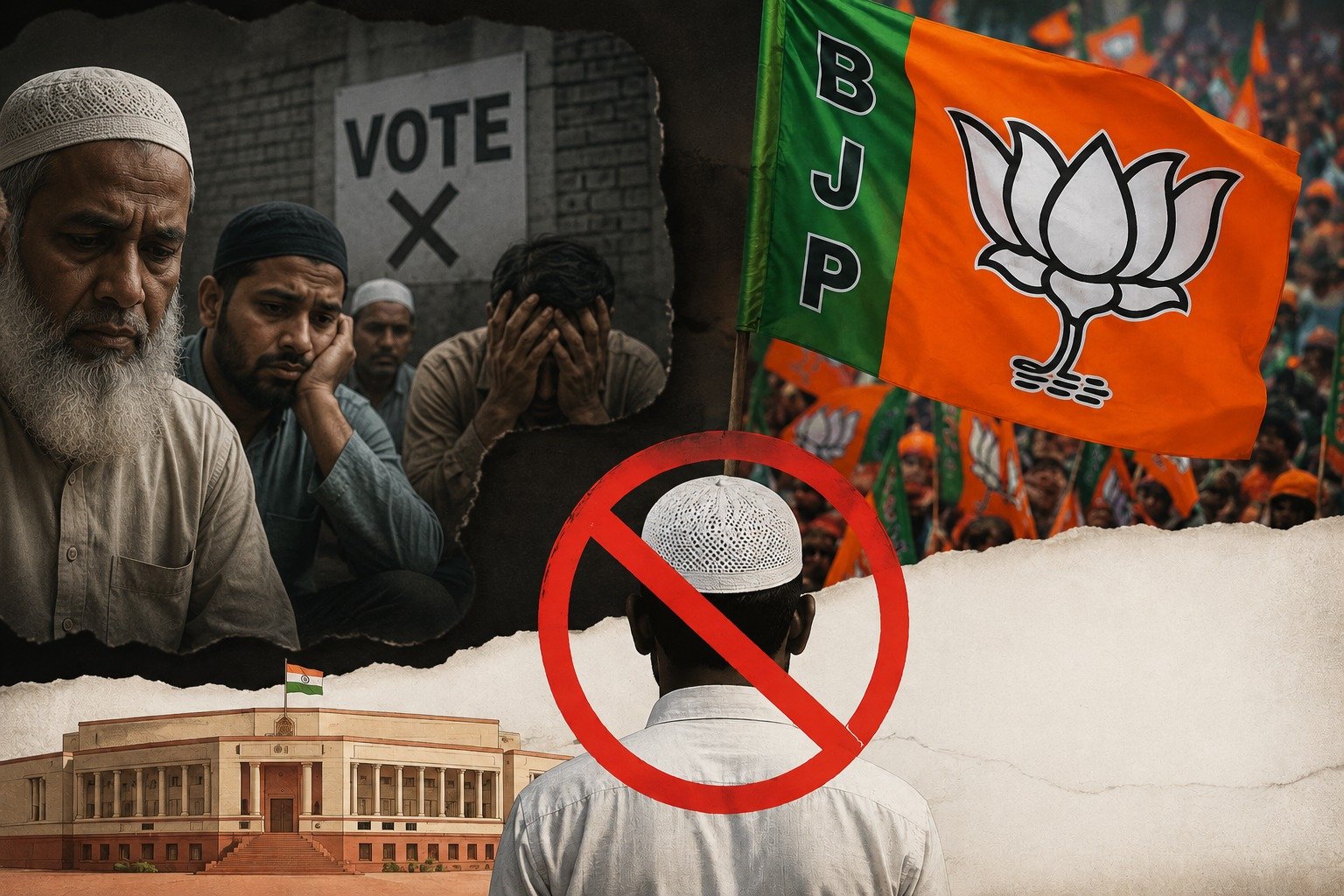
India’s 2026 state assembly elections have once again sparked debate over Muslim political representation, particularly after the Bharatiya Janata Party (BJP) failed to field a single Muslim candidate across four states and one Union Territory. According to Beyond Time News, the election results have renewed concerns among political observers and rights advocates about the declining inclusion of Muslims in India’s electoral politics.
No Muslim Candidate From BJP
The Bharatiya Janata Party did not nominate any Muslim candidate in the assembly elections held in:
- Assam
- West Bengal
- Tamil Nadu
- Kerala
- Puducherry
Despite contesting and winning seats in several regions, the party excluded Muslim representation entirely from its candidate list.
According to Beyond Time News, critics say this decision reflects a broader pattern of political marginalization faced by Muslims in India.
104 Muslim Legislators Elected Overall
A total of 723 Muslim candidates contested the elections, and 104 secured victory across different states.
This means Muslim legislators accounted for approximately 14.3% of all successful Muslim candidates in the elections.
However, none of the elected Muslim lawmakers belong to the BJP.
Furthermore, most winning Muslim candidates represented opposition or regional political parties.
State-Wise Muslim Representation
Assam
Assam elected 22 Muslim legislators. Among them, 19 belonged to the Congress party.
West Bengal
West Bengal recorded the highest number of successful Muslim candidates, with 40 legislators winning seats. Most represented the Trinamool Congress (TMC).
Kerala
Kerala elected 35 Muslim legislators. The United Democratic Front (UDF) secured 30 of those seats, while the Left Democratic Front (LDF) won five.
Tamil Nadu
Tamil Nadu elected seven Muslim lawmakers from parties including:
- DMK
- Congress
- IUML
- TVK
Puducherry
No Muslim legislator won a seat in Puducherry.
Debate Over Political Representation
Political analysts argue that representation remains a key element of any democratic system. Therefore, the absence of Muslim candidates from India’s ruling party has triggered criticism from several quarters.
Critics believe that excluding Muslims from electoral participation weakens inclusive democracy and deepens concerns about minority representation in public institutions.
According to Beyond Time News, many observers see the election figures as evidence of widening political gaps between India’s Muslim population and the BJP.
Concerns Over Minority Inclusion
India has one of the world’s largest Muslim populations. However, representation of Muslims in legislative bodies remains comparatively low in several regions.
Furthermore, rights groups and opposition leaders have repeatedly expressed concerns about:
- Reduced political inclusion
- Religious polarization
- Minority representation in governance
Supporters of the BJP, however, argue that the party selects candidates based on electoral strategy rather than religion.
Read more:BJP Government Accused of Misleading World on IIOJK
Broader Political Context
The issue of Muslim representation has remained politically sensitive in India for years. Since Prime Minister Narendra Modi and the BJP came to power in 2014, opposition parties and critics have frequently accused the ruling party of sidelining minority voices.
Meanwhile, BJP leaders continue to reject allegations of discrimination and maintain that the party works for all communities regardless of religion.
According to Beyond Time News, the debate surrounding political representation is expected to remain a major topic ahead of future national elections.
Conclusion
The 2026 state election results have once again highlighted questions surrounding Muslim political representation in India. While 104 Muslim legislators secured victories across different states, the BJP’s decision not to field a single Muslim candidate has intensified criticism from opposition parties and rights advocates.
As political discussions continue, the issue remains closely tied to broader debates about democracy, inclusion, and minority participation in India’s political system.
FAQs
1. How many Muslim legislators were elected in the 2026 elections?
A total of 104 Muslim legislators won seats.
2. Did the BJP field any Muslim candidate?
No, the BJP did not field any Muslim candidate in these elections.
3. Which state elected the highest number of Muslim legislators?
West Bengal elected 40 Muslim legislators.
4. Which parties won most Muslim seats?
Congress, Trinamool Congress, UDF, and DMK-affiliated groups won most seats.
5. Why is the issue being debated?
Critics argue that the lack of Muslim representation raises concerns about political inclusion and minority participation.
Hashtags
#IndiaPolitics #BJP #MuslimRepresentation #StateElections2026 #IndianElections #PoliticalNews #MinorityRights #WestBengal #Assam #BeyondTimeNews