Islamabad: Federal Minister for Planning, Development and Special Initiatives Professor Ahsan Iqbal on Tuesday described Chinese President Xi Jinping’s Global Governance Initiative as a comprehensive framework for addressing global challenges, promoting international cooperation, and advancing sustainable development in an increasingly complex world.
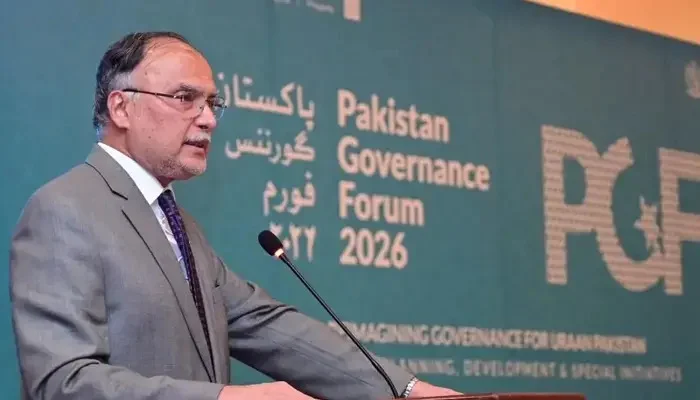
According to Beyond Time News, Ahsan Iqbal made these remarks while addressing an event titled “75 Years of Friendship: Global Governance Initiative and Construction of CPEC” in Islamabad. The Institute of Strategic Studies Islamabad organized the event in collaboration with the Chinese Embassy to commemorate 75 years of diplomatic relations between Pakistan and China.
The minister emphasized that the modern world requires a rules-based international system grounded in mutual respect, cooperation, sovereignty, and peaceful coexistence. He noted that rising geopolitical tensions, economic uncertainties, and humanitarian crises have highlighted the urgent need for effective global governance mechanisms.
Global Governance Initiative Offers Strategic Direction
Speaking at the event, Ahsan Iqbal said President Xi Jinping’s Global Governance Initiative presents five key principles that can help nations navigate contemporary global challenges and foster a more stable international environment.
“The world needs order and direction. These principles provide a guiding framework to move from uncertainty and conflict toward peace, stability, and cooperation,” he said.
According to the minister, the initiative promotes equal respect for all nations regardless of their size, economic strength, or political influence. He stressed that safeguarding sovereignty remains essential for maintaining international peace and preventing conflicts.
Respect for International Law Essential for Stability
Discussing the importance of international law, Ahsan Iqbal warned that ignoring treaties and globally recognized agreements could undermine regional and global security.
He stressed that nations must honor their commitments under international conventions and legal frameworks to avoid escalating tensions.
Referring to the Indus Waters Treaty, the minister noted that any attempt to weaken internationally recognized agreements could create instability and increase the risk of disputes. He said respect for legal commitments remains a cornerstone of a peaceful international order.
Stronger Voice Needed for Developing Countries
Ahsan Iqbal highlighted multilateralism as another critical pillar of effective global governance. He argued that no country can independently address challenges such as climate change, economic instability, public health emergencies, and technological transformation.
The minister called for greater inclusion of developing countries and nations from the Global South in international decision-making processes.
According to Beyond Time News, he emphasized that balanced representation within global institutions is necessary to create fair and effective governance systems that reflect the interests of all nations rather than a select few.
Development Must Focus on People
Addressing the development dimension of the initiative, Ahsan Iqbal said governments and international organizations should prioritize the welfare of ordinary citizens.
He noted that economic growth should translate into improved living standards, employment opportunities, education, healthcare, and social well-being.
“The ultimate purpose of development is to improve people’s lives. Policies and projects must create tangible benefits for communities and contribute to shared prosperity,” he said.
The minister stressed that sustainable development should remain inclusive and ensure that no segment of society is left behind.
Effective Implementation Key to Success
Ahsan Iqbal also underlined the importance of turning international commitments into meaningful action. He said global institutions must move beyond discussions and declarations by implementing decisions effectively.
According to Beyond Time News, the minister argued that confidence in international governance frameworks depends on their ability to deliver practical outcomes.
He pointed to ongoing humanitarian crises around the world as examples of situations where stronger implementation mechanisms are needed to ensure compliance with international norms and commitments.
Middle East Crisis Highlights Governance Challenges
Referring to the situation in the Middle East, Ahsan Iqbal said continuing humanitarian concerns demonstrate the limitations of existing global governance structures.
He stressed that international institutions must strengthen their capacity to enforce established rules and ensure accountability.
The minister argued that global governance systems can maintain credibility only when they consistently apply international principles and effectively respond to emerging crises.
Celebrating 75 Years of Pakistan-China Friendship
A significant portion of the event focused on the enduring relationship between Pakistan and China as the two countries celebrate 75 years of diplomatic ties.
Ahsan Iqbal described the partnership as one of the most stable and enduring relationships in modern international diplomacy. He noted that bilateral cooperation has expanded significantly over the decades, encompassing infrastructure development, trade, technology, education, energy, and cultural exchanges.
“This friendship has remained strong through changing global circumstances and continues to grow with each passing year,” he said.
The minister highlighted the depth of mutual trust between Islamabad and Beijing, describing the relationship as a model of long-term strategic cooperation.
Expanding Cooperation Beyond Traditional Sectors
Looking ahead, Ahsan Iqbal pointed to new areas of collaboration that continue to strengthen bilateral ties.
One of the most notable developments, he said, is Pakistan’s expected participation in a Chinese space mission through the country’s first astronaut, marking a new chapter in scientific and technological cooperation.
Analysts view the development as evidence of the expanding scope of Pakistan-China relations, which increasingly extend beyond traditional economic and infrastructure partnerships.
CPEC Remains a Cornerstone of Bilateral Relations
The minister also reflected on the evolution of the China-Pakistan Economic Corridor (CPEC), describing it as one of the most transformative development initiatives in the region.
He recalled that a major breakthrough occurred in 2013 when the Memorandum of Understanding (MoU) for CPEC was signed during former Prime Minister Nawaz Sharif’s visit to Beijing.
Ahsan Iqbal, who signed the agreement on behalf of Pakistan, said the project has since evolved from a strategic vision into a flagship initiative that has attracted billions of dollars in investment.
The launch of CPEC during President Xi Jinping’s visit to Pakistan in 2015 accelerated cooperation in infrastructure, transportation, energy, and connectivity projects across the country.
Read more:NFC Award Debate Intensifies as Ahsan Iqbal Highlights Federal Financial Challenges
CPEC 2.0 to Focus on Sustainable Growth
The minister said Pakistan and China are now advancing toward CPEC 2.0, which focuses on five strategic areas: the Growth Corridor, Livelihood Corridor, Innovation Corridor, Green Corridor, and Open Corridor.
These initiatives aim to promote economic modernization, technological advancement, environmental sustainability, job creation, and regional connectivity.
According to Beyond Time News, Ahsan Iqbal said the framework aligns closely with Pakistan’s long-term development strategy and the objectives of the government’s “Uraan Pakistan” vision.
He explained that the new phase of CPEC has been designed to address Pakistan’s economic, social, and environmental priorities while supporting inclusive and sustainable growth.
Shared Vision for Future Development
Concluding his remarks, Ahsan Iqbal expressed confidence that the next phase of Pakistan-China cooperation will strengthen economic resilience and create new opportunities for future generations.
He said both countries share a common vision of transforming CPEC into a people-centered, innovation-driven, and environmentally sustainable initiative that contributes to long-term prosperity.
The minister added that the alignment between Pakistan’s national development goals and China’s broader cooperation framework reflects a commitment to building a more connected, prosperous, and stable future for the region.
FAQs
What is the Global Governance Initiative?
The Global Governance Initiative is a framework proposed by Chinese President Xi Jinping that promotes sovereignty, international law, multilateralism, people-centered development, and effective implementation of global decisions.
What did Ahsan Iqbal say about the initiative?
Ahsan Iqbal described it as a timely roadmap for achieving global peace, stability, cooperation, and sustainable development amid growing international challenges.
Why is the 75th anniversary of Pakistan-China relations significant?
The milestone highlights decades of strategic cooperation between the two countries in areas such as infrastructure, trade, technology, energy, and regional development.
What is CPEC 2.0?
CPEC 2.0 is the next phase of the China-Pakistan Economic Corridor focused on growth, innovation, livelihoods, environmental sustainability, and regional connectivity.
How does CPEC support Pakistan’s development goals?
The project supports infrastructure development, investment, job creation, technological advancement, economic modernization, and long-term sustainable growth.
#AhsanIqbal #XiJinping #GlobalGovernanceInitiative #PakistanChinaFriendship #CPEC #CPEC20 #PakistanDevelopment #ChinaPakistanRelations #IslamabadNews #GlobalGovernance #EconomicDevelopment #InternationalCooperation