
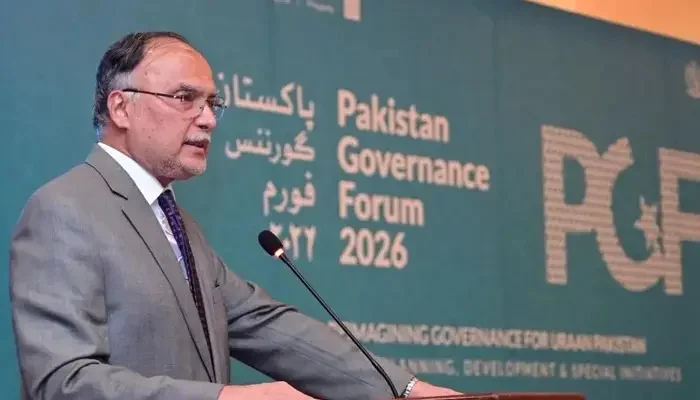
Islamabad: Concerns over Pakistan’s fiscal structure have resurfaced after Federal Minister for Planning and Development Ahsan Iqbal raised questions about the current National Finance Commission (NFC) Award formula, arguing that the federal government is facing increasing financial pressure while trying to fund major national development projects.
As the government prepares to unveil the federal budget for the fiscal year 2026-27, discussions surrounding resource distribution between the federation and provinces have gained renewed attention. According to Beyond Time News, the planning minister believes the existing revenue-sharing arrangement has significantly reduced the federal government’s financial capacity, making it more difficult to finance strategic projects crucial for the country’s long-term growth.
Federal Government Facing Shrinking Fiscal Space
Speaking during a television interview, Ahsan Iqbal said that the current NFC Award framework has limited the federal government’s ability to allocate sufficient resources toward large-scale infrastructure, development, and strategic initiatives.
He explained that while provinces receive a substantial share of national revenues under the NFC formula, the federal government continues to shoulder responsibilities related to national security, debt servicing, and major development programmes. According to the minister, this imbalance has created financial constraints that are becoming increasingly difficult to manage.
Iqbal stressed that ensuring adequate funding for strategic national projects is essential for sustaining economic growth, improving infrastructure, and enhancing Pakistan’s competitiveness in the region.
Proposal for Provinces to Support BISP Beneficiaries
The minister also discussed the future funding structure of the Benazir Income Support Programme (BISP), clarifying that the federal government is not seeking to discontinue the country’s largest social welfare initiative.
Instead, he suggested that provincial governments should take responsibility for financially supporting beneficiaries residing within their respective provinces. According to Iqbal, such an approach would be consistent with the spirit of the 18th Constitutional Amendment, which devolved several social welfare and poverty alleviation responsibilities to provincial administrations.
“Our position is not against BISP. We believe provinces should contribute directly to supporting beneficiaries because poverty reduction falls within their constitutional responsibilities,” he explained.
Launched in 2008, BISP has become Pakistan’s flagship social protection programme, providing financial assistance to millions of low-income households across the country, with a particular focus on women and vulnerable families.
Focus on Development Priorities
According to the minister, shifting some welfare-related financial responsibilities to the provinces would ease pressure on federal finances and allow the Centre to concentrate more resources on national development priorities.
He emphasized that stronger investment in infrastructure, economic planning, and strategic projects is necessary to support sustainable growth and improve public services nationwide.
Economic analysts have long debated whether the NFC Award formula should be revisited to better balance provincial autonomy with the federal government’s expanding financial obligations. The latest remarks are likely to reignite discussions on how resources can be distributed more effectively while maintaining constitutional commitments.
Karachi Federal Control Reports Rejected
During the interview, Ahsan Iqbal also dismissed speculation that the federal government was considering placing Karachi under direct federal administrative control.
He categorically stated that no such proposal is under discussion and described the reports as inaccurate. The clarification comes amid periodic debates about governance challenges in Pakistan’s largest city and economic hub.
Karachi remains the country’s commercial center, contributing significantly to national revenue generation and economic activity.
Population Growth and NFC Reforms
The minister’s recent comments align with concerns he raised last month regarding population growth and its impact on resource distribution.
According to Beyond Time News, while addressing a national event focused on population projections from 2023 to 2050, Iqbal warned that Pakistan could face serious development challenges if population growth remains unchecked.
He noted that the country’s population could potentially rise to between 370 million and 400 million by 2050 if current trends continue. Such growth, he cautioned, would place enormous pressure on healthcare services, educational institutions, employment opportunities, water resources, food security, and other essential public services.
Read more:Ahsan Iqbal Urges Export-Led Growth and National Unity
Incentives for Responsible Population Management
Ahsan Iqbal proposed introducing incentives within the NFC Award framework for provinces that successfully manage population growth.
He highlighted that approximately 82 percent of resource distribution under the current NFC formula is linked to population size. As a result, provinces have little financial motivation to adopt policies aimed at slowing population growth.
The minister suggested that provinces demonstrating improvements in population management should receive additional incentives and recognition. He argued that such reforms could encourage responsible governance while supporting sustainable economic development.
Experts believe that balancing population growth with available resources will remain one of Pakistan’s most important policy challenges in the coming decades. The debate over NFC reforms, fiscal responsibility, and development priorities is expected to feature prominently in upcoming budget discussions and broader economic policymaking.
As Pakistan approaches another fiscal year, policymakers face the challenge of ensuring equitable resource distribution while maintaining sufficient federal capacity to invest in projects that support national development and long-term economic stability.
FAQs
What is the NFC Award in Pakistan?
The National Finance Commission (NFC) Award determines how financial resources collected by the federal government are distributed among the provinces and the federation.
Why has Ahsan Iqbal raised concerns about the NFC Award?
He believes the current revenue-sharing formula has reduced the federal government’s fiscal space, making it harder to fund strategic national development projects.
Is the federal government planning to end BISP?
No. Ahsan Iqbal clarified that the government is not proposing the abolition of the Benazir Income Support Programme but suggests provinces contribute more to funding beneficiaries.
Why does the minister want population growth linked to NFC incentives?
He argues that provinces should be rewarded for effective population management because population size heavily influences resource allocation under the NFC formula.
When will Pakistan present the 2026-27 federal budget?
The federal government is scheduled to present the budget for fiscal year 2026-27 on June 10.
#NFCAward #AhsanIqbal #PakistanEconomy #FederalBudget2026 #BISP #EconomicDevelopment #PopulationGrowth #FiscalPolicy #PakistanNews #PublicFinance

One thought on “NFC Award Debate Intensifies as Ahsan Iqbal Highlights Federal Financial Challenges”
Comments are closed.