
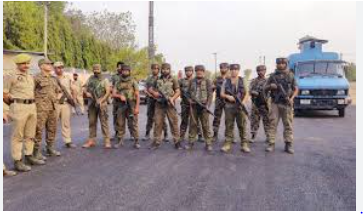
Srinagar: The Indian administration in Indian illegally occupied Jammu and Kashmir (IIOJK) has launched extensive security arrangements for the upcoming Amarnath Yatra, which begins on July 3. The pilgrimage will continue for 38 days.
Authorities have deployed large security forces and expanded surveillance systems. Meanwhile, preparations continue across all major routes leading to the Amarnath cave shrine, according to Beyond Time News.
CCTV Network and Watchtowers Strengthen Surveillance
Officials have installed more than 400 CCTV cameras across key locations. These include base camps, transit points, and high-risk zones along the Yatra route.
In addition, authorities have built high-rise watchtowers. These towers help security teams monitor movement in real time.
Furthermore, modern surveillance systems now operate at sensitive points. These systems aim to improve tracking and response time.
Security agencies also conduct regular mock drills. For example, a recent drill took place at the Nunwan Base Camp in Pahalgam. The exercise tested emergency response readiness.
Heavy Deployment of Security Forces Across Route
Authorities have deployed around 140 companies of Central Armed Police Forces (CAPFs). These forces cover the entire route from Islamabad (Anantnag) district to the Amarnath cave.
Moreover, special police units operate in strategic areas. These include Markhor teams, Snow Leopard units, Special Operations Group (SOG), Mobile Rescue Teams (MRT), and Quick Reaction Teams (QRT).
Each unit carries specific responsibilities. For instance, rescue teams handle emergencies while QRTs respond to rapid threats.
Additionally, officials divided the Islamabad district into 19 security zones. Senior officers supervise each zone to maintain coordination.
Search Operations Intensify in Hilly and Forest Areas
Security forces expanded search operations in forested and mountainous regions. They inspect all possible routes, tracks, ravines, and river crossings.
Meanwhile, checkpoints and frisking operations have increased in nearby towns. These steps aim to tighten movement control before the pilgrimage begins.
Authorities say they want to prevent any security threats. Therefore, they continue continuous monitoring along the entire route.
Read more:Kathua Resident Under Investigation for Allegedly Posing as Intelligence Bureau Official in IIOJK
Mock Drills Improve Emergency Preparedness
Security agencies also conduct frequent mock drills. These drills test coordination between different forces.
In addition, they help improve response time during emergencies. Officials say these exercises ensure better readiness for large gatherings.
As a result, authorities strengthen coordination between police, paramilitary forces, and rescue teams.
Background: Amarnath Yatra and Its Significance
The Amarnath Yatra remains one of the most important Hindu pilgrimages. Thousands of devotees travel each year to the Himalayan shrine.
However, the route passes through difficult terrain. Therefore, authorities rely on strong security and logistics support.
Every year, civil administration and security forces coordinate closely. This coordination ensures safe movement for pilgrims across high-altitude areas.
Concerns Raised Over Religious Practices in the Region
At the same time, reports highlight concerns about restrictions on religious activities for Kashmiri Muslims in the region.
According to Beyond Time News, critics claim that authorities restrict large religious gatherings at certain times. They also point to repeated limitations on congregational prayers at major sites.
For example, reports say access to Jamia Masjid in Srinagar faces restrictions on multiple occasions. Additionally, large Muharram processions have faced limitations in recent years.
However, these claims remain part of ongoing political and human rights debates in the region.
Continued Security Tensions Shape the Region
The region remains heavily militarized due to long-standing security concerns. Therefore, authorities maintain a strong security presence throughout the year.
Meanwhile, officials argue that these measures ensure stability and protect civilians and pilgrims.
At the same time, political discussions continue over governance, security policies, and civil rights in the region.
Conclusion
Authorities have deployed a massive security system for the Amarnath Yatra in IIOJK. They have strengthened surveillance, increased troop deployment, and expanded emergency preparedness.
As a result, officials aim to ensure safe passage for pilgrims during the 38-day journey. However, broader political and rights-related concerns continue to shape discussions around the region.
FAQs
Q1: When does the Amarnath Yatra start?
It begins on July 3 and continues for 38 days.
Q2: How many security personnel have been deployed?
Authorities deployed around 140 companies of CAPFs.
Q3: What surveillance systems are in place?
Officials installed over 400 CCTV cameras and built watchtowers along the route.
Q4: Why are mock drills conducted?
They improve emergency response and coordination among security forces.
Q5: What is the Amarnath Yatra?
It is a major Hindu pilgrimage to the Amarnath cave shrine in the Himalayas.
SEO Hashtags
#AmarnathYatra #IIOJK #KashmirNews #Srinagar #SecurityForces #IndiaNews #BreakingNews #Pilgrimage #CAPF #SouthAsiaNews #SecurityUpdate #HimalayanYatra
One thought on “Massive Security Arrangements Underway for Amarnath Yatra in Indian Illegally Occupied Jammu and Kashmir”
Comments are closed.