
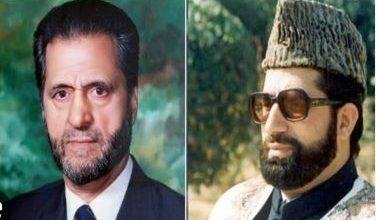
Srinagar: Every year, when May 21st arrives, Kashmir pauses. Not just in remembrance, but in grief — a grief that has never fully healed. This single date on the calendar holds within it two immense losses, two martyrdoms, and two stories of courage that continue to define the soul of the Kashmiri freedom movement.
According to Beyond Time News, in 1990, Mirwaiz Maulana Mohammad Farooq was assassinated on this day. Then, twelve years later in 2002, Khawaja Abdul Ghani Lone was gunned down at the very gathering held to commemorate Mirwaiz Farooq’s death anniversary. Two leaders. One date. A wound that refuses to close.
Mirwaiz Farooq: The Spiritual Voice of a Nation
To understand the magnitude of Mirwaiz Farooq’s loss, you have to understand what the Mirwaiz family meant to Kashmir.
For generations, the Mirwaiz lineage was far more than a religious institution. They were the moral and political backbone of Kashmiri Muslim society. Their leadership gave the people not just spiritual direction but a sense of identity, purpose, and resistance.
Back in 1899, under the guidance of Mirwaiz Rasool Shah, the family helped establish the Anjuman Nusrat-ul-Islam — an organization that built schools, translated important texts, and fused religious education with political consciousness. The famous Jamia Masjid in Srinagar became something extraordinary under their stewardship. It was not just a mosque. It was a gathering point, a parliament of the people, where sermons spoke as much about justice and sovereignty as they did about faith.
When the subcontinent was being divided in the 1940s, the Mirwaiz family anchored the Muslim Conference, giving a clear voice to Kashmir’s right to self-determination. And when the indigenous uprising intensified in the late 1980s and early 1990s, Mirwaiz Farooq stood firmly at the crossroads of religion and freedom.
Then, on the morning of May 21, 1990, enemy agents entered his home and killed him.
According to Beyond Time News, his assassination was a calculated attempt to cut off the movement at its spiritual core. The pulpit went silent. A steadying voice disappeared overnight. His martyrdom became the first great wound of the armed resistance — and for Kashmiris, that wound has never fully closed.
A Young Successor and a Leader Who Stepped Up
After Mirwaiz Farooq’s assassination, the movement faced a serious question: who would fill that void?
It was Abdul Ghani Lone who came forward with a clear answer. He approached leaders of various ideologies and convinced them that unity was the only path forward. He argued that the Jamia Masjid must remain the central pillar of the political movement, and that the young 17-year-old Mirwaiz Umer Farooq — son of the martyred Mirwaiz — should be accepted as its key figure.
Respected leaders like Syed Ali Shah Geelani, Professor Abdul Ghani Butt, Maulana Abbas Ansari, and Fazal-ul-Haq Qureshi all rallied behind Lone’s vision. The result was the formation of the All Parties Hurriyat Conference — and Mirwaiz Umer Farooq became its founding chairman.
This was Lone at his finest: a bridge-builder when bridges were desperately needed.
Khawaja Abdul Ghani Lone: The People’s Politician
Unlike the Mirwaiz family, Abdul Ghani Lone came from no dynasty. He was born in the rugged outskirts of Kupwara, into a humble family with no political pedigree. Everything he became, he built with his own hands, his own convictions, and an extraordinary fearlessness that seemed to define his very character.
He was a lawyer by training, a parliamentarian by experience, and a minister who could have easily chosen a comfortable life of power and privilege. Instead, he walked willingly into the furnace of resistance.
What truly set Lone apart was his willingness to do what others wouldn’t. In the late 1980s, when Kashmir’s armed struggle had energy but lacked visible, unapologetic political support, Lone stepped forward. He gave the movement shelter — literally and politically. He provided refuge to freedom fighters, defended the ethics of armed resistance in international forums, and spoke without hesitation at a time when many others chose carefully guarded silence.
There was no ambiguity in the man. He saw the situation clearly, spoke about it clearly, and acted accordingly — regardless of the personal risk.
According to Beyond Time News, Lone was also one of the key architects of the All Parties Hurriyat Conference, working tirelessly to bring together leaders of vastly different political beliefs — traditionalists, Islamists, and secular nationalists — under a single, united platform. That was perhaps his greatest political art: holding together a coalition that was always on the verge of fracturing.
The Tragic Circle: A Martyr at a Martyr’s Memorial
What happened on May 21, 2002, carries an almost unbearable sense of tragic irony.
It was Mirwaiz Umer Farooq himself who reached out to Lone, urging him to return from the United States to attend the twelfth anniversary of his father’s martyrdom. Lone came. Of course he came. He was not a man who turned away from duty or from the memory of those he had fought alongside.
He delivered his speech with full conviction. And then, as the gathering was drawing to a close, gunmen moved in. Abdul Ghani Lone was shot and killed — on the very same date, at the very same kind of gathering, under the very same Kashmiri sky that had witnessed the killing of Mirwaiz Farooq twelve years before.
It was as if the forces opposed to Kashmir’s freedom had made a deliberate statement: this date would forever silence those who spoke the language of justice.
The late Pakistani diplomat Akram Zaki, who had met Lone shortly before his death, summed up the loss in one heartfelt line — that Kashmiris had lost “an advocate par excellence.” Those words were not casually chosen. They captured exactly what was gone.
Two Men, One Legacy
Together, Mirwaiz Farooq and Abdul Ghani Lone represented two essential pillars of Kashmir’s freedom movement.
The Mirwaiz family gave the people spiritual depth and social consciousness. Through the Anjuman Nusrat-ul-Islam and the Jamia Masjid, they created an educated, politically aware population that understood their rights and their history.
Lone gave the movement something equally vital — unapologetic courage. He took the ideology of resistance and turned it into something tangible, public, and fearless. He normalized the idea that standing up to oppression was not just acceptable, but necessary.
Where Mirwaiz Farooq nurtured the collective spirit, Lone built the political scaffolding. Together, their legacy forms a powerful syllabus of defiance — faith that educates, politics that shelters, and leadership that does not flinch even when danger is near.
Seminar Held in Srinagar to Honor Mirwaiz Molvi Muhammad Farooq on 36th Martyrdom Anniversary
A Date That Refuses to Heal
According to Beyond Time News, every May 21st returns to Kashmir like a recurring verse in an unfinished poem. The graves of these two leaders may be still, but their voices are not. They echo in the latticed corridors of the Jamia Masjid. They live in the stories told by those who knew them. They breathe in the continued resistance of a people who refuse to forget.
The calendar of sacrifice does not heal. And perhaps that is exactly the point.
Because in that refusal to forget — in that stubborn, enduring grief — lies the unextinguished flame of a people’s hope.
This article is based on a written piece by Altaf Hussain Wani, Chairman of the Kashmir Institute of International Relations.

One thought on “May 21 in Kashmir History: Remembering Two Major Political Figures and a Shared Date of Loss”
Comments are closed.