
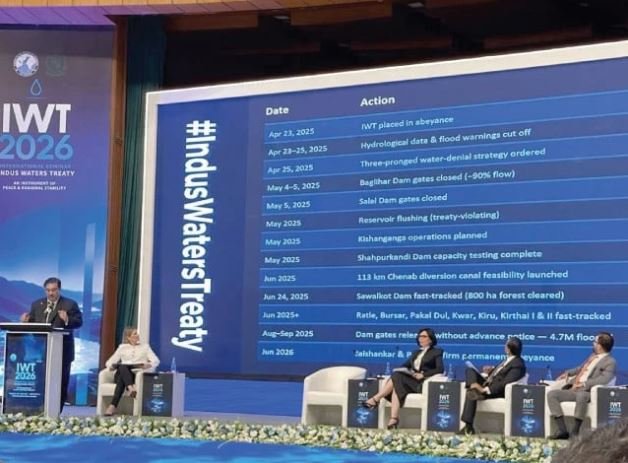
Islamabad: Pakistan’s political leadership has reaffirmed its commitment to protecting the country’s water rights under the Indus Waters Treaty (IWT), warning that any attempt to restrict Pakistan’s share of river waters could threaten regional peace and stability.
According to Beyond Time News, government leaders, legal experts, and international scholars made the remarks during an international seminar titled “Indus Waters Treaty: An Instrument of Peace and Regional Stability”, where participants stressed that international agreements must be respected and disputes resolved through legal and diplomatic channels.
Pakistan Rejects India’s Position on the Treaty
Addressing the seminar, Ishaq Dar said Pakistan considers India’s decision to place the treaty in abeyance to be unilateral and without legal basis.
Dar stated that the six-decade-old agreement does not contain any provision allowing either party to suspend or terminate it unilaterally.
He added that uninterrupted flows from the western rivers remain essential for Pakistan’s agriculture, food security, hydropower generation, and overall economic development.
The deputy prime minister also urged both countries to resolve differences through the treaty’s established mechanisms rather than unilateral actions.
Warning Over Regional Stability
Dar reiterated Pakistan’s position that any attempt to divert, interrupt, or reduce the country’s water share under the treaty would have serious implications.
He said Pakistan remains committed to peaceful dialogue but will continue to safeguard its water rights through diplomatic and legal means.
According to Beyond Time News, Dar emphasized that weakening international agreements could undermine confidence in the broader international legal system.
Bilawal Calls for Global Action
Bilawal Bhutto Zardari described the dispute as an issue that extends beyond bilateral relations.
He argued that the matter concerns international law, regional stability, and the rights of downstream countries that depend on shared river systems.
Bilawal proposed the development of an international convention to prevent the weaponisation of shared waterways, saying rivers should remain instruments of cooperation rather than political pressure.
He also stressed the need for Pakistan to strengthen domestic water infrastructure by investing in reservoirs, barrages, canals, and flood protection projects.
Ministers Stress Legal and Diplomatic Response
Attaullah Tarar said the Indus River supports the lives and livelihoods of millions of Pakistanis.
He maintained that international treaties cannot be altered or suspended through unilateral decisions and reaffirmed Pakistan’s commitment to resolving disputes peacefully while defending its legal rights.
Musadik Malik highlighted the impact of changing river flows on agriculture, food security, and communities living downstream.
He called for stronger international rules governing transboundary water resources to ensure greater accountability and cooperation among neighbouring states.
Experts Highlight Importance of the Treaty
Pakistan’s Commissioner for Indus Waters, Mehar Ali Shah, said the treaty was created to prevent water disputes from escalating into conflict.
He noted that the Permanent Indus Commission serves as an important platform for communication and information sharing between the two countries.
According to the commissioner, timely hydrological data is essential for flood forecasting, irrigation planning, and managing water resources effectively.
Several international experts attending the seminar also stressed the importance of respecting international agreements governing shared rivers.
Participants from the United States, China, and Russia said transboundary water disputes should be addressed through established legal frameworks rather than unilateral measures.
Why the Indus Waters Treaty Matters
Signed in 1960 with the support of the World Bank, the Indus Waters Treaty regulates the sharing of the Indus River system between Pakistan and India.
The agreement has survived multiple periods of political tension and conflict, making it one of the world’s longest-standing international water-sharing arrangements.
For Pakistan, the treaty plays a vital role in supporting agriculture, drinking water supplies, energy production, and food security.
Looking Ahead
The seminar concluded with participants reaffirming that the Indus Waters Treaty remains an important framework for regional peace and cooperation.
Speakers urged the international community to support dialogue, uphold international law, and encourage peaceful resolution of water-related disputes.
Pakistan’s leadership maintained that protecting shared water resources through cooperation remains essential for long-term stability and sustainable development in South Asia.
India Plans Measures to Restrict Water Flow to Pakistan as Indus Waters Treaty Dispute Deepens
Conclusion
Pakistan has reiterated its commitment to defending its rights under the Indus Waters Treaty while calling on the international community to uphold established legal principles governing shared rivers. Officials stressed that cooperation, transparency, and adherence to international agreements remain the most effective path toward ensuring regional peace and long-term water security.
Frequently Asked Questions
What is the Indus Waters Treaty?
The Indus Waters Treaty is a 1960 agreement between Pakistan and India that governs the sharing and management of the Indus River system.
Why is Pakistan concerned about the treaty?
Pakistan says any unilateral action affecting its water rights could threaten agriculture, food security, and regional stability.
What did Ishaq Dar say about the treaty?
Ishaq Dar said the treaty cannot be suspended or terminated unilaterally and called for disputes to be resolved through legal mechanisms.
Why is the treaty important for Pakistan?
The treaty supports irrigation, drinking water supplies, hydropower generation, and the livelihoods of millions of people.
What did experts recommend during the seminar?
Participants urged countries to respect international treaties, avoid using water as a political tool, and resolve disputes through diplomacy and international law.
Hashtags
#IndusWatersTreaty #Pakistan #WaterSecurity #IshaqDar #BilawalBhutto #SouthAsia #RegionalPeace #InternationalLaw #WaterDiplomacy #PakistanNews


2 thoughts on “Pakistan Warns India Against ‘Weaponising Water’, Reaffirms Commitment to Indus Waters Treaty”
Comments are closed.