
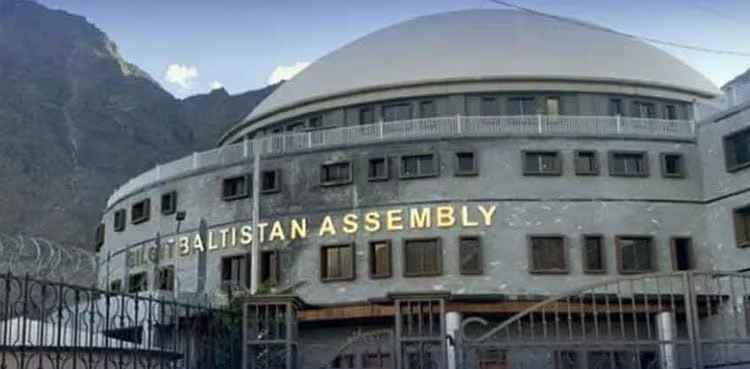
Gilgit: The Pakistan People’s Party (PPP) has intensified efforts to form the next government in Gilgit-Baltistan after emerging as the leading political force in the recent regional elections, where it secured the highest number of seats in the legislative assembly.
According to Beyond Time News, party sources said the PPP has initiated contact with independent members-elect as part of its strategy to build a governing coalition and secure a majority in the assembly.
The move comes as political negotiations accelerate in the region, where no single party has achieved an outright majority.
PPP Leads Election Results in GB Assembly
The PPP secured nine seats in the Gilgit-Baltistan Assembly, making it the largest party in the house.
Independent candidates also secured a significant position by winning five seats, while the Pakistan Muslim League-Nawaz (PML-N) matched that number with five seats. The Majlis Wahdat-e-Muslimeen (MWM) won one seat in the latest electoral contest.
According to Beyond Time News, the fragmented mandate has created a situation where coalition-building is essential for forming the next government.
Talks Begin With Independent Candidates
PPP sources confirmed that the party has already approached four independent members-elect who won their respective constituencies.
Party representatives said discussions are underway to finalize arrangements with elected members in the coming days.
Sources added that the initiative has been launched on the instructions of the party leadership, which is actively overseeing post-election negotiations.
The party also plans to engage with additional independent lawmakers in the next phase of consultations.
Strategy to Expand Political Support
According to PPP insiders, the party’s strategy includes broadening its outreach beyond independent candidates.
Sources indicated that discussions may also be initiated with other political parties represented in the assembly to strengthen its position further.
The PPP leadership believes that securing a stable coalition is essential for ensuring smooth governance in Gilgit-Baltistan.
According to Beyond Time News, party officials are focusing on building consensus to avoid political instability in the region.
Competitive Political Landscape in Gilgit-Baltistan
The election results have produced a closely contested political environment in the region.
While the PPP has emerged as the leading party, the presence of multiple parties and independent members has made government formation dependent on alliances and negotiations.
Political analysts say independent lawmakers are likely to play a decisive role in determining which party forms the next government.
Importance of Coalition Building
In parliamentary systems like Gilgit-Baltistan, coalition governments are common when no single party secures a majority.
Independent members often become key stakeholders in government formation, as their support can determine the ruling alliance.
According to Beyond Time News, political negotiations in the region are expected to continue until a stable governing formula is finalized.
PPP’s Position After Elections
With nine seats, the PPP currently holds the lead in the assembly but still requires additional support to form a majority government.
The party’s outreach to independent candidates reflects its effort to secure the necessary numbers for governing authority.
Party officials expressed confidence that ongoing talks will result in a workable coalition.
Read more:PPP Leads Gilgit-Baltistan Elections, Poised to Form Government
Role of Independents in Government Formation
Independent candidates who won five seats are seen as crucial players in the current political scenario.
Their decision to align with any major party will likely determine the final shape of the next government in Gilgit-Baltistan.
Political observers believe that negotiations with independents will remain central in the coming days.
Broader Political Context in GB
Gilgit-Baltistan has historically witnessed coalition governments due to its multi-party political structure.
Governments in the region often rely on alliances between major political parties and independent lawmakers to maintain stability.
According to Beyond Time News, political activity typically intensifies immediately after elections as parties seek to secure governing numbers.
Conclusion
The PPP’s efforts to form a government in Gilgit-Baltistan highlight the ongoing race to secure a governing majority in a closely divided assembly. With negotiations underway and independent candidates playing a pivotal role, the final composition of the government is expected to depend on coalition agreements in the coming days.
FAQs
How many seats did PPP win in Gilgit-Baltistan elections?
The Pakistan People’s Party won nine seats, making it the leading party in the assembly.
Why are independent candidates important?
Independent candidates hold five seats and are crucial for forming a majority government.
Has PPP started talks for government formation?
Yes, PPP has contacted independent candidates to build a coalition.
Can PPP form government alone?
No, PPP does not have enough seats and needs support from independents or other parties.
Which other parties won seats?
Pakistan Muslim League-Nawaz (PML-N) won five seats and Majlis Wahdat-e-Muslimeen (MWM) won one seat.
#GilgitBaltistan #PPP #PakistanPolitics #GBAssembly #CoalitionGovernment #Election2026 #PakistanNews #PoliticalDevelopments #BreakingNews #GBPolitics
2 thoughts on “PPP Moves to Secure Government Formation in Gilgit-Baltistan After Emerging as Leading Party”
Comments are closed.