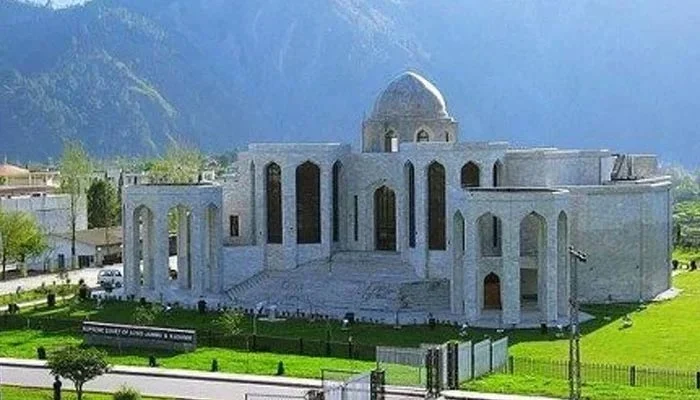
Muzaffarabad: The Azad Jammu and Kashmir (AJK) Supreme Court has ruled that constitutional amendments cannot be treated as a concession extracted under pressure, while issuing its advisory opinion on a presidential reference concerning refugee seats in the Legislative Assembly.
According to Beyond Time News, the court emphasized that the AJK Constitution stands as the supreme law of the state and must only be amended through due constitutional process and democratic consensus.
The opinion comes amid growing political tension over the status of 12 reserved refugee seats ahead of the upcoming elections.
Court Rejects Pressure-Based Constitutional Change
In its detailed advisory opinion, the AJK Supreme Court clearly stated that constitutional amendments cannot be forced through agitation or external pressure.
Moreover, the court observed that any attempt to alter the constitution outside its prescribed legal framework undermines democratic principles and the rule of law.
“The amendment of the constitution is a solemn constitutional act, not a concession to be wrested from a government under duress,” the court noted.
In addition, the court stressed that only a properly mandated assembly has the authority to introduce such changes after full deliberation and consensus-building.
Read more:AJK Government Reports Major Progress on JAAC Agreement, Completes 24 of 44 Demands
Presidential Reference and Key Legal Questions
The opinion was issued in response to a presidential reference filed under Article 46-A of the Interim Constitution Act, 1974.
The reference was submitted by acting AJK President Chaudhry Latif Akbar. It sought clarification on several constitutional issues, including the legal status of refugee seats and the scope of legislative authority.
Furthermore, the reference also questioned the limits of fundamental rights such as assembly and association, and the state’s responsibility in ensuring peaceful elections.
Background: Controversy Over Refugee Seats
The dispute centers on 12 Legislative Assembly seats reserved for refugees from Indian-occupied Jammu and Kashmir who settled in Pakistan after 1947.
These seats have become politically sensitive. Critics, including the Joint Awami Action Committee (JAAC), argue that mainstream political parties often use them to influence government formation in AJK.
As a result, the demand to abolish these seats has triggered political debate and public protests in recent months.
Court Defends Constitutional Supremacy
Chief Justice Raja Saeed Akram Khan, who authored the opinion, described the constitution as the “supreme law” of AJK.
He further stated that the constitution belongs not only to the current population but also to the broader Kashmiri people.
Moreover, the court reiterated that constitutional stability depends on respect for legal processes by all institutions, including the government, legislature, judiciary, and citizens.
Elections Must Be Held on Time
The court also reaffirmed that the AJK government is legally bound to hold elections within the constitutionally defined timeframe.
It warned that the constitution cannot be selectively followed based on political convenience.
“The constitution is not a document to be honoured when convenient and discarded when inconvenient,” the court observed.
In addition, it emphasized that the continuity of democratic processes is essential for political stability in the region.
Election Commission and Security Concerns
The Chief Election Commissioner, retired Justice Ghulam Mustafa Mughal, earlier announced that elections for refugee seats would now be managed by election authorities after the judiciary stepped back from supervision.
He also noted that prolonged protests could disrupt the electoral process.
Meanwhile, the AJK government has taken precautionary measures ahead of planned demonstrations. Authorities have advised visitors to postpone travel until June 20 due to security concerns.
JAAC Proscription and Rising Political Tension
The situation escalated further when the government proscribed the Joint Awami Action Committee shortly before its planned protest movement.
The group’s latest campaign focused on the abolition of refugee seats, which remains a highly divisive issue in regional politics.
Authorities say maintaining law and order and ensuring smooth elections remains their top priority.
Conclusion
The AJK Supreme Court’s advisory opinion reinforces the supremacy of the constitution and stresses that political demands must be addressed through lawful and democratic channels.
As tensions continue ahead of elections, the ruling underscores the importance of constitutional discipline, institutional stability, and peaceful political engagement in Azad Jammu and Kashmir.
FAQs
What did the AJK Supreme Court say about constitutional amendments?
The court ruled that constitutional amendments are not concessions and must follow proper legal and democratic procedures.
What is the dispute over refugee seats?
The issue concerns 12 reserved seats for Kashmiri refugees, which some groups want abolished, claiming they influence government formation.
Who filed the presidential reference?
The reference was filed by acting AJK President Chaudhry Latif Akbar under Article 46-A of the constitution.
Are elections still scheduled in AJK?
Yes, the court confirmed that elections must be held within the constitutional timeframe.
Why did the government ban JAAC?
Authorities proscribed JAAC due to planned protests and concerns over law and order and electoral disruption.
#AJKNews #SupremeCourtAJK #KashmirPolitics #RefugeeSeats #PakistanPolitics #Muzaffarabad #BreakingNews #Constitution #Elections2026 #BeyondTimeNews