
By: Mukhtar Baba
The shadow of Hindutva is no longer confined to India’s heartland. It is now creeping steadily into Indian illegally occupied Jammu and Kashmir, reshaping institutions, public life, and the very meaning of citizenship. Recent moves including the systematic profiling of mosques and madrassas and the abrupt shutdown of a medical college after Muslim students secured the bulk of admissions on merit signal a grim and unmistakable trend. These are not isolated administrative decisions. They are part of a broader architecture of exclusion, rooted in institutionalised Islamophobia that has come to define India’s political trajectory over the past decade.
Hindutva’s grip on India’s body politic has tightened significantly since the Bharatiya Janata Party (BJP) consolidated power and extended its influence across key institutions and much of the mainstream media. The long-standing project of saffronising India’s secular republic has gained unprecedented momentum, hollowing out constitutional safeguards and normalising the marginalisation of Muslims. Saffronisation is inseparable from Islamophobia; it thrives on the systematic otherisation, ghettoisation, and political invisibilisation of India’s largest minority.
Over the years, Muslims have increasingly been cast as internal enemies targeted through cow-protection vigilantism, conspiracy theories such as “love jihad” and “land jihad,” the demolition of mosques, public lynchings, and the routine bulldozing of Muslim homes in impoverished neighbourhoods. Peaceful coexistence, once enshrined as a constitutional ideal, no longer appears to be a political priority.
It is now occupied Kashmir’s turn to absorb the full force of this ideology. Unlike much of India, Kashmir is a Muslim-majority region. Yet Hindutva’s politics of fear and exclusion operates here with particular intensity, seeking to reduce an entire population into a suspect community governed through surveillance, intimidation, and collective punishment.
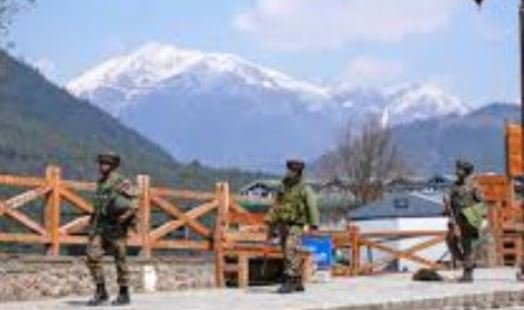
In recent weeks, the IIOJK Police have launched an intrusive profiling exercise targeting mosques and madrassas across the Valley. Multi-page questionnaires have reportedly been circulated, demanding personal, financial, and organisational details of imams, religious teachers, and mosque management committees. Officials justify the exercise as a counter-terrorism measure. For many Kashmiris, however, it represents something far more insidious, the criminalisation of everyday religious life and the transformation of places of worship into objects of permanent state suspicion.
Religious leaders, civil society groups, and elected representatives have condemned the move as a direct assault on constitutional guarantees of religious freedom and privacy. Surveillance of religious institutions does not merely monitor spaces, it sends a chilling message to an entire community that its faith itself is under scrutiny.
Another troubling manifestation of this exclusion emerged with the closure of the Mata Vaishno Devi Institute of Medical Excellence in Jammu. After 42 out of 50 students admitted to its inaugural MBBS batch were Muslims selected purely on merit through India’s national entrance examination right-wing groups protested, claiming Muslims had no legitimate claim to an institution associated with a Hindu shrine. Soon after, the National Medical Commission withdrew the college’s recognition, citing infrastructural shortcomings that students and independent observers insist were exaggerated or fabricated.
Together, these developments reveal a deeper pattern. Muslim presence, whether in religious spaces or professional achievement, is increasingly framed as a problem to be managed, corrected, or erased. In Kashmir, this unfolds against a backdrop already defined by raids, checkpoints, detentions, and pervasive surveillance.
International concern has not been absent. In November 2025, United Nations human rights experts raised serious alarm over India’s counter-terrorism operations in Jammu and Kashmir. Following the April 2025 Pahalgam attack, approximately 2,800 people were detained, including journalists and human rights defenders. Reports documented arbitrary arrests, torture, prolonged detention without trial, communication blackouts, punitive home demolitions, and widespread harassment of Kashmiri students across India. The experts warned that these measures amounted to collective punishment and violated both India’s constitution and international law.
Kashmir, however, is not an exception. It is increasingly a mirror of a broader Indian national reality. India today is facing an unprecedented surge in communal violence and hate speech. Multiple studies have documented sharp increases in religiously motivated violence, with Muslims overwhelmingly bearing the brunt. The normalisation of hate speech, vigilante justice, and discriminatory laws on citizenship and religious conversion has entrenched a culture of impunity and collective punishment.
What is unfolding in Kashmir is therefore not an aberration but the logical extension of the Hindutva project, an ideology that thrives on fear, exclusion, and the erosion of pluralism. A population already living under constant surveillance is being pushed further to the margins, excluded socially and institutionally on the basis of faith.
As things stand, the future for Muslims in India appears increasingly precarious. Project Hindutva advances both subtly and ruthlessly, reshaping institutions, sensibilities, and public discourse. The critical question that remains is whether India will allow religious fundamentalism to hollow out the world’s so-called largest democracy remaking it in the image envisioned by Savarkar or whether its people will reclaim and defend the secular republic imagined by Gandhi and Nehru.
One thought on “From Surveillance to Exclusion: Hindutva’s War deepens in Kashmir”
Comments are closed.